
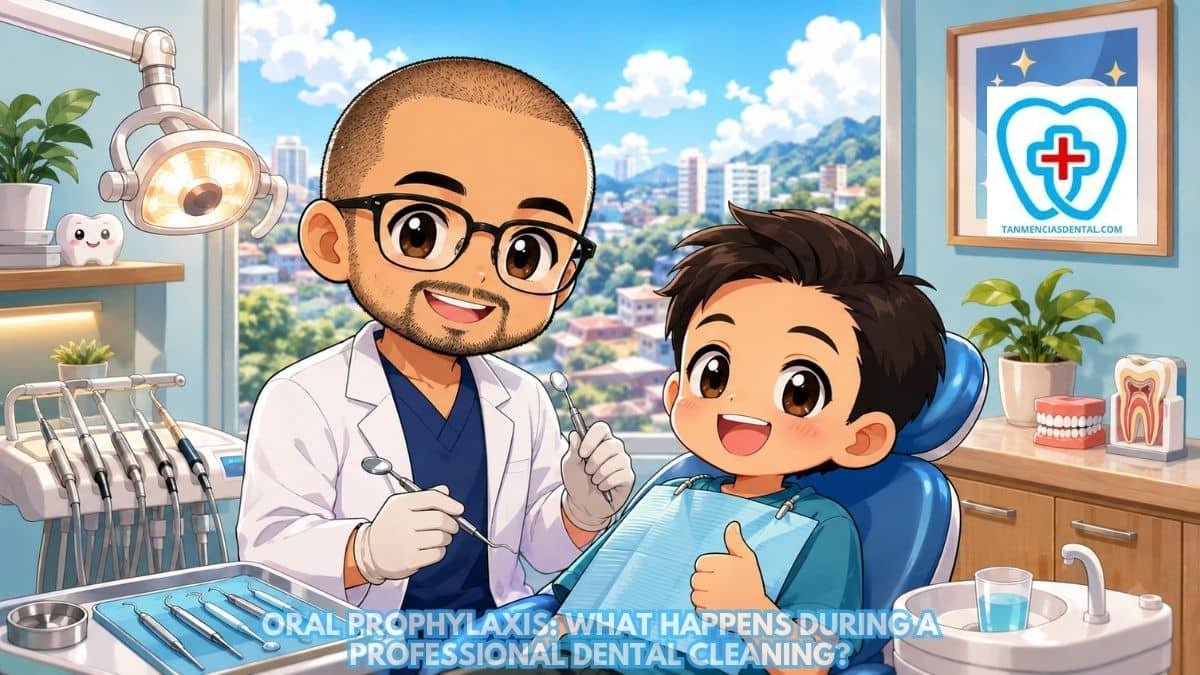
You brush your teeth every day and maybe floss regularly, too. So, do you still need to visit your dentist for professional cleaning?
For most people, yes.
Oral prophylaxis, often simply called professional dental cleaning, teeth cleaning, or “linis” in the Philippines, is a preventive dental procedure that removes plaque, hardened tartar (dental calculus), and certain surface stains from the teeth. In Philippine dental practice, the term is widely used; Philippine Department of Health facilities commonly list oral prophylaxis or scaling and polishing among their preventive dental services.
Even if you’re diligent about brushing, tartar can develop in areas that are difficult to clean. Once plaque has mineralized into tartar, ordinary brushing won’t remove it. Professional instruments are needed.
So, what actually happens when you sit in the dental chair for oral prophylaxis? Here’s what you can generally expect.
Key Takeaways
- Oral prophylaxis is a preventive dental cleaning that removes plaque, tartar, and certain stains from your teeth.
- Scaling is the key part of the procedure. Polishing may also be performed to remove residual plaque and surface stains and leave the teeth feeling smoother.
- Tartar can’t be adequately removed with ordinary brushing once it has hardened. It requires professional removal.
- Oral prophylaxis isn’t the same as deep cleaning. Scaling and root planing is periodontal treatment that may be recommended when gum disease has progressed beyond gingivitis.
- Not everyone needs exactly the same cleaning schedule. Your dentist can recommend an interval based on the condition of your teeth and gums and your individual risk factors.
- Oral prophylaxis complements, not replaces, brushing twice daily, cleaning between the teeth, and maintaining regular dental checkups.
- Procedures such as dental X-rays and fluoride application may be recommended during a dental visit, but they aren’t automatically part of oral prophylaxis itself.
What Is Oral Prophylaxis?
Oral prophylaxis is essentially a professional cleaning intended to help maintain the health of your teeth and gums.
The American Dental Association defines dental prophylaxis as the removal of plaque, calculus, and stains from tooth structures to control local irritational factors. In the Philippines, “oral prophylaxis” is a familiar term used by both private dental clinics and government health facilities, with DOH facilities also referring to it as scaling and polishing.
To understand why you need it, it helps to know the difference between plaque and tartar.
Plaque is the soft, sticky film that continuously develops on your teeth and contains bacteria and their byproducts. You can remove much of it at home through proper brushing and cleaning between your teeth.
If plaque isn’t removed adequately, however, it can mineralize and harden into dental calculus, commonly called tartar.
And that’s where the problem begins: once tartar has formed, your toothbrush can’t simply brush it away. Professional removal is needed.
🦷 Dentist vs. Doctor: Which Professional Should You Consult for Your Health Concerns?
What Happens During Oral Prophylaxis?
The exact procedure can vary depending on the condition of your teeth and gums, how much tartar has accumulated, and the practices of your dental clinic.
Generally, here’s what you can expect.
1. Your Teeth and Gums Are Checked
Before cleaning begins, your dental professional may examine your mouth and assess the condition of your teeth and gums.
They may look for:
- Plaque and tartar buildup
- Redness, swelling, or bleeding of the gums
- Signs of tooth decay
- Gum recession
- Existing fillings, crowns, bridges, implants, or other dental work
- Areas that may require further evaluation
This is important because not every dental problem hurts.
Some oral conditions can progress without producing obvious symptoms, which is one reason regular professional dental examinations remain important.
Depending on what your dentist finds and your dental history, additional diagnostic procedures such as dental X-rays may be recommended. These are separate from the prophylaxis itself and aren’t necessarily required at every cleaning appointment.
🦷 Is It Too Late To Start Brushing My Teeth? Why It’s Never Too Late for a Brighter Smile!
2. Plaque and Tartar Are Removed Through Scaling
This is the main part of oral prophylaxis.
Your dentist or dental hygienist uses specialized instruments to remove plaque, tartar, and stains from the surfaces of your teeth. Scaling can be performed using hand instruments, ultrasonic instruments, or a combination of techniques.
An ultrasonic scaler uses rapid vibrations to help break up deposits and usually sprays water at the same time. The water helps cool the instrument and flush loosened debris from the area while suction removes excess fluid.
If you’ve never had professional cleaning before, the scraping, buzzing, water, and suction can seem unusual, but these sensations are expected.
How much scaling you need depends largely on how much buildup is present. If you maintain excellent oral hygiene and receive regular professional care, there may be relatively little tartar to remove. If you’ve gone a long time without a cleaning, the procedure may take longer.
🦷 Dentist vs. Orthodontist: Understanding the Key Differences in Dental Care
3. Your Teeth May Be Polished
After scaling, your dental professional may polish your teeth when appropriate.
Polishing commonly involves a small rotating rubber cup or brush and a mildly abrasive polishing paste. It can help remove residual plaque and certain extrinsic stains, meaning stains on the outer surfaces of your teeth.
Afterward, your teeth may feel noticeably smoother.
But here’s an important distinction:
Polishing isn’t the same as teeth whitening.
Professional cleaning can make teeth look cleaner or brighter by removing deposits and some surface stains, but it doesn’t necessarily change the natural internal color of your teeth. Teeth whitening or bleaching is a different procedure.
🦷 Interesting Things About Dry Brushing Your Teeth You Need to Know!
4. Areas Between the Teeth Are Cleaned and Checked
Your dental professional may also clean between your teeth and inspect areas that are difficult for you to reach at home.
This is a good time to ask questions.
If your gums frequently bleed when you floss, food keeps getting stuck between particular teeth, or you’re having difficulty cleaning around braces, bridges, implants, or other dental work, mention it.
Your dentist or dental hygienist can show you techniques or recommend appropriate interdental cleaning tools.
Registered dental hygienists are recognized professionals in the Philippines and may perform preventive oral-hygiene procedures such as scaling and polishing under the supervision of a licensed dentist, as provided under Philippine dental law.
🦷 Can You Brush Your Teeth 3 Times A Day? What Dentists Wish You Knew
5. Your Mouth Is Rinsed
During and after the procedure, water and suction are generally used to remove loosened deposits, polishing material, and saliva.
Once the cleaning is finished, many patients immediately notice how smooth their teeth feel, particularly around areas where tartar had accumulated.
🦷 Can Tooth Decay Kill You? Dangers of Neglected Dental Health
6. Additional Preventive Treatment May Be Recommended
Depending on your individual needs, your dentist may recommend other preventive services, such as a professional fluoride treatment.
Fluoride can help protect teeth against decay by supporting remineralization and making tooth surfaces more resistant to acid-related mineral loss.
However, it’s important to distinguish these services from oral prophylaxis itself.
Fluoride treatment isn’t automatically part of professional dental cleaning. Philippine DOH dental facilities, for example, list oral prophylaxis and fluoride therapy as separate preventive dental services.
Your dentist can determine whether fluoride treatment or another preventive procedure is appropriate for you.
🦷 How Does Restoring My Teeth Affect My Overall Physical Health
Does Oral Prophylaxis Hurt?
For many people with relatively healthy teeth and gums, oral prophylaxis causes little or no significant discomfort.
During cleaning, you might experience:
- Pressure or vibration
- A scraping sensation
- Sensitivity to cold water
- Mild gum tenderness
- Some bleeding from inflamed gums
If you have significant tartar buildup, exposed tooth roots, sensitive teeth, or inflamed gums, cleaning may be more uncomfortable.
Don’t be afraid to tell your dentist if you’re uncomfortable. They can adjust their technique, give you breaks, and discuss options for managing sensitivity.
Bleeding during a cleaning can also happen when the gums are already inflamed. Red, swollen, tender, or bleeding gums are common signs of gingivitis and periodontal disease.
If your gums regularly bleed when you brush or floss, or continue bleeding after your dental appointment, don’t simply assume it’s normal. Mention it to your dentist.
🦷 Can You Get Gingivitis From Kissing? The Truth Behind Oral Hygiene and Romance
How Long Does Oral Prophylaxis Take?
There’s no universal answer because every mouth is different.
Someone with relatively little plaque and tartar may have a straightforward cleaning. Another person with heavy calculus deposits and staining may require considerably more time.
The type of appointment matters as well. A visit involving a dental examination, X-rays, restorative evaluation, or other procedures will naturally take longer than oral prophylaxis alone.
So, rather than worrying about whether your cleaning takes 20 minutes, 30 minutes, or longer, what’s more important is whether your teeth and gums have been properly assessed and treated according to their condition.
🦷 Basic Dental Needs in Marikina
Oral Prophylaxis vs. Deep Cleaning: What’s the Difference?
People sometimes use “cleaning” and “deep cleaning” interchangeably, but they’re not the same thing.
Oral prophylaxis is preventive care intended to remove plaque, tartar, and stains and help maintain oral health.
A deep cleaning, often referring to scaling and root planing, is periodontal treatment that cleans affected areas below the gumline and around the roots of teeth.
Periodontitis is more serious than gingivitis because it involves destruction of the tissues supporting the teeth, including bone loss. Depending on its severity, treatment may include scaling and root planing and, in some cases, additional periodontal treatment.
Philippine government dental facilities likewise distinguish oral prophylaxis from scaling and root planing as separate dental services.
So, if your dentist recommends periodontal treatment instead of an ordinary cleaning, it doesn’t simply mean they’re offering you a “more thorough” version of prophylaxis. The recommendation may be based on a different diagnosis and different treatment needs.
🦷 Dependable Family Dental Services in Marikina City
What About Periodontal Maintenance?
There’s another distinction that’s worth knowing if you’ve previously been treated for periodontitis.
After periodontal treatment, your dentist may recommend ongoing periodontal maintenance rather than treating future appointments as ordinary preventive cleanings.
These maintenance visits are intended to help control periodontal disease over the long term. The procedures and frequency may differ from routine prophylaxis depending on the condition of your gums, periodontal pockets, bone support, and other clinical findings.
If you’ve previously received treatment for gum disease, ask your dentist what type of maintenance schedule is appropriate for you.
Why Do You Need Professional Cleaning If You Brush Every Day?
This is probably one of the most common questions about oral prophylaxis.
Good brushing and interdental cleaning are extremely important, but they don’t make professional dental care unnecessary.
Think of the two as working together.
Your home routine controls plaque every day. Professional cleaning removes tartar and deposits that remain or develop despite your home care.
Plaque can be removed through good oral hygiene, but once it mineralizes into tartar, brushing alone isn’t enough to remove it.
Professional cleaning can therefore help:
- Remove hardened tartar
- Reduce plaque accumulation
- Remove certain surface stains
- Support healthier gums
- Help control gingivitis
- Identify areas that you’re having difficulty cleaning
- Provide an opportunity for personalized oral-hygiene advice
Gingivitis, the early, inflammatory form of gum disease, is largely preventable and treatable through a combination of good daily oral hygiene and appropriate professional cleaning.
However, professional cleaning isn’t a reset button.
Having your teeth cleaned doesn’t mean you can neglect brushing and flossing until your next appointment. What you do at home every day remains a major part of maintaining healthy teeth and gums.
How Often Should You Have Oral Prophylaxis?
You’ve probably heard that you should have your teeth cleaned every six months.
Six-month dental visits are a familiar schedule, but the appropriate interval isn’t necessarily identical for everyone.
How frequently you need professional cleaning can depend on factors such as:
- Your gum health
- How quickly you accumulate plaque and tartar
- Your risk of developing cavities
- Your oral-hygiene habits
- Smoking or tobacco use
- Dry mouth
- Certain medical conditions and medications
- Your history of gingivitis or periodontitis
- Braces, implants, or other dental appliances and restorations
Some people may require more frequent professional care, particularly if they’re managing periodontal disease or have other significant risk factors.
The important point is simple: don’t assume everyone needs exactly the same cleaning schedule.
Your dentist can assess your individual situation and tell you when you should return.
What Should You Do After Oral Prophylaxis?
For uncomplicated routine cleaning, most people can return to their normal activities right away.
You may experience temporary gum tenderness or tooth sensitivity, particularly if substantial tartar was removed or your gums were inflamed.
Afterward, your job is to maintain the clean surfaces you’ve just been given.
That means:
Brush thoroughly twice a day, clean between your teeth every day, and follow any specific recommendations from your dentist.
You should also avoid using excessive pressure when brushing. Brushing harder doesn’t necessarily mean brushing better. Proper technique and consistency are more important.
If you received fluoride or another treatment in addition to your cleaning, follow the specific eating, drinking, and brushing instructions provided by your dental clinic.
When Should You See a Dentist Instead of Waiting for Your Next Cleaning?
You don’t need to wait for your next scheduled prophylaxis if something seems wrong.
Arrange a dental consultation if you notice problems such as:
- Persistent toothache
- Swollen or painful gums
- Gums that frequently bleed
- Pus or swelling around a tooth or the gums
- A loose permanent tooth
- Significant gum recession
- A broken or cracked tooth
- Persistent sensitivity
- A mouth sore or unusual lesion that doesn’t heal
- Facial or jaw swelling
Remember that pain isn’t the only sign of dental disease. Some oral conditions may progress before obvious symptoms appear.
That’s one reason regular dental examinations are valuable even when your teeth seem perfectly fine.
Frequently Asked Questions About Oral Prophylaxis
1. Is oral prophylaxis the same as teeth cleaning?
Yes, in everyday use. Oral prophylaxis is the professional removal of plaque, tartar, and certain stains from the teeth. In the Philippines, you may also hear patients simply call it “linis.”
2. Is oral prophylaxis the same as scaling?
Scaling is the main process used to remove plaque, tartar, and stains from tooth surfaces. Oral prophylaxis may also involve polishing when appropriate. Philippine health facilities commonly describe the service as oral prophylaxis or scaling and polishing.
3. Can oral prophylaxis remove tartar?
Yes. Removing tartar is one of the primary purposes of professional cleaning. Once plaque has hardened into tartar, ordinary toothbrushing can’t adequately remove it.
4. Can oral prophylaxis whiten my teeth?
Not in the same way as a teeth-whitening treatment.
Cleaning can remove some external stains and deposits, so your teeth may look cleaner and brighter afterward. But it won’t necessarily change the underlying natural color of your teeth.
5. Does oral prophylaxis damage tooth enamel?
When appropriately performed by a qualified dental professional, routine scaling and polishing are intended to remove deposits from tooth surfaces, not healthy enamel.
If you have very sensitive teeth, exposed roots, dental restorations, implants, or another dental condition, tell your dentist so the procedure can be adapted to your needs.
6. Why do my gums bleed during cleaning?
Inflamed gums can bleed when they’re brushed, flossed, or professionally cleaned. Gingivitis commonly causes red, swollen, or bleeding gums.
If your gums bleed frequently or persistently, tell your dentist so the underlying cause can be evaluated.
7. Can I have oral prophylaxis if I have sensitive teeth?
In many cases, yes. Let your dentist know about your sensitivity before the procedure begins. The cleaning technique can often be adjusted, and your dentist can investigate what’s causing the sensitivity.
8. Do I still need oral prophylaxis if I brush and floss every day?
Regular home care can greatly reduce plaque accumulation, but it doesn’t reliably remove tartar once it has formed. Professional cleaning also gives your dental team an opportunity to identify areas where deposits are accumulating and help you improve your home-care technique.
9. Is deep cleaning better than oral prophylaxis?
Neither is inherently “better”; they’re used for different situations.
Oral prophylaxis is preventive cleaning. Scaling and root planing is periodontal treatment that may be required when gum disease has progressed beyond what routine cleaning can address.
If your dentist recommends deep cleaning, ask about the diagnosis and why periodontal treatment is necessary.
10. Do I need dental X-rays every time I get my teeth cleaned?
Not necessarily. Dental X-rays are diagnostic tools and aren’t automatically part of oral prophylaxis. Your dentist should determine whether they’re appropriate based on your oral health, dental history, symptoms, previous X-rays, and clinical findings.
11. How often should I have my teeth professionally cleaned?
Many patients are accustomed to six-month dental visits, but the ideal schedule depends on your individual oral health. Your dentist may recommend a different interval depending on your gum condition, cavity risk, tartar buildup, previous periodontal disease, and other factors.
The Bottom Line
Oral prophylaxis isn’t just about making your teeth look cleaner or feel smoother.
It’s preventive dental care that removes plaque, hardened tartar, and certain surface stains that can contribute to problems with your teeth and gums. Just as importantly, your dental visits give your dentist an opportunity to evaluate your oral health and identify problems that you might not notice yourself.
But remember: professional cleaning and home oral care aren’t substitutes for each other.
Your dentist can remove tartar that you can’t brush away. You, meanwhile, have the much bigger day-to-day job of controlling plaque through consistent brushing and cleaning between your teeth.
Work on both.
Maintain good oral hygiene at home, pay attention to changes in your teeth and gums, and follow the professional cleaning schedule your dentist recommends based on your individual needs.
Your mouth doesn’t have to hurt before it deserves professional care.
Medical Disclaimer
This article is provided for general educational and informational purposes only and isn’t intended to replace professional dental or medical advice, diagnosis, or treatment. Oral-health needs and appropriate treatment vary from person to person. Consult a licensed dentist or other qualified healthcare professional for recommendations based on your individual medical and dental history and a clinical examination. If you have severe tooth pain, significant swelling, persistent bleeding, signs of infection, facial swelling, difficulty swallowing or breathing, or another urgent dental concern, seek prompt professional care.
Self-Promotion
If you’re due for a dental cleaning or have concerns about your teeth and gums, visit us at Tan-Mencias Dental Clinic at 44 G. Del Pilar Street, Parang, Marikina City. Our dental team is here to help you care for your smile and answer your questions about your dental health. To reach us, you can call our clinic, send us a message through our Facebook page, or use the contact form on our website. You can also call us at 0917-145-1074 if you have any questions or concerns. We look forward to welcoming you to our clinic and helping you keep your teeth and gums healthy.