
If you’ve ever had a traditional dental impression, you may remember biting into a tray filled with impression material and waiting for it to set. Traditional impressions remain useful in dentistry, but many dental practices now have another option for suitable cases: digital oral scanning.
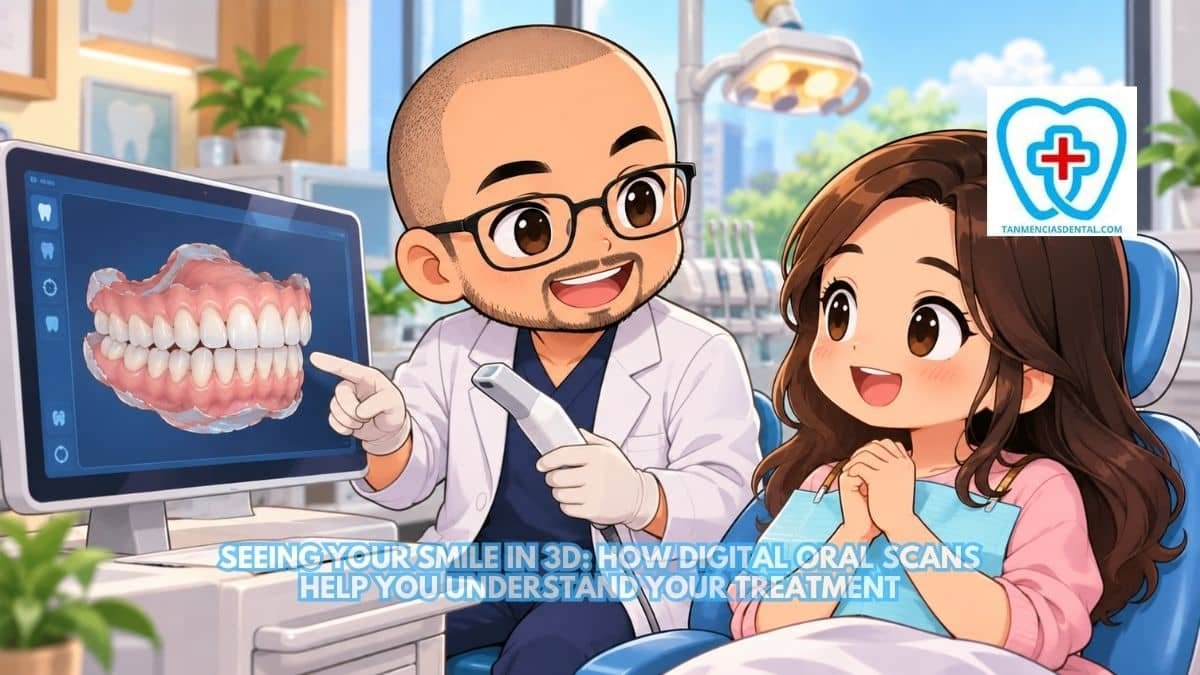
A digital oral scan creates a detailed, three-dimensional model of your teeth and other visible structures inside your mouth. Instead of simply hearing your dentist describe what they see, you may be able to look at a 3D model of your own teeth on a screen.
This can make a significant difference in how you understand your dental care. Your dentist can rotate the model, enlarge certain areas, and show you features that may be relevant to your treatment.
In other words, digital scanning doesn’t just give your dentist useful information. It can also help you become a more informed participant in decisions about your oral health.
Key Takeaways
- Digital oral scanners create detailed 3D models of your teeth and other visible oral structures.
- Seeing your mouth in 3D can make dental conditions and treatment recommendations easier to understand.
- Digital scans can be used in the planning and fabrication of crowns, bridges, clear aligners, retainers, dental implant restorations, and other treatments, depending on the case.
- Scans may also provide useful digital records that can help your dental team monitor certain changes over time.
- Digital scanning is often more comfortable for patients who dislike conventional impression material, although individual experiences vary.
- An intraoral scan does not replace a comprehensive dental examination, and it does not provide the same information as dental X-rays or CBCT scans.
What Is a Digital Oral Scan?
A digital oral scan, commonly called an intraoral scan, is created with a small handheld device known as an intraoral scanner.
Your dental professional moves the scanner around your mouth while it captures information about the visible surfaces of your teeth and surrounding oral structures. Specialized software processes this information to create a three-dimensional digital model.
The completed model can usually be rotated, enlarged, and viewed from multiple angles. Depending on the purpose of the scan, your dental team can use it to examine the shape and position of your teeth, spacing, alignment, bite, and other features relevant to your care.
For you as a patient, one of the biggest benefits is simple: you can see more of what your dentist is seeing.
🦷 From Scan to Crown: How Digital Impressions Help Create Dental Restorations
What Happens During a Digital Scan?
The scanning process is generally straightforward and noninvasive.
Your dental professional guides a scanning wand around your upper and lower teeth. As different areas are captured, a 3D model begins appearing on the computer screen.
Your bite may also be recorded while your teeth are together. This helps the software capture information about how your upper and lower teeth relate to each other.
Unlike conventional impressions, digital scanning does not usually require a tray of impression material to remain in your mouth while the material sets. This can be particularly helpful for patients who dislike the taste or sensation of impression materials or who have a sensitive gag reflex.
Another practical advantage is that your dental professional can usually inspect the digital scan immediately. If an area hasn’t been captured clearly enough, that particular section may be rescanned without necessarily starting the entire process again.
Scanning time varies according to the equipment, the area being scanned, your individual anatomy, and the purpose of the scan.
🦷 How Digital Oral Scans Help Plan Clear Aligner Treatment
Why Seeing Your Mouth in 3D Matters
Dentists are trained to interpret what they see during an examination and in dental images and models. As a patient, however, it can be difficult to picture what’s happening based on a verbal explanation alone.
Imagine being told, “This tooth has worn down,” or “Your teeth are becoming crowded.”
You may understand the words without fully visualizing the problem.
With a 3D model, your dentist can point to the area being discussed, rotate the image, enlarge it, and show its relationship to the surrounding teeth.
That can change the conversation. Instead of simply being told what’s happening, you and your dentist can look at the area together.
🦷 Digital Oral Scans vs. Traditional Dental Impressions: What’s the Difference?
How Digital Scans Can Help You Understand Your Treatment
One of the most useful aspects of digital dentistry is improved communication between you and your dental team.
If you’re considering orthodontic treatment, for example, a scan can help your dentist or orthodontist explain crowding, spacing, tooth position, or aspects of your bite.
If you’re having restorative treatment, the digital model may help illustrate the shape and position of the tooth being treated and its relationship with neighboring and opposing teeth.
Depending on the treatment and software being used, you may also be shown a digital simulation or visualization of a possible treatment outcome.
It’s important to understand the difference between a scan and a simulation. The 3D scan represents captured information about your mouth at the time of scanning, while a treatment simulation is a computer-generated prediction or visualization.
A simulated result can be useful for discussing treatment goals, but it isn’t a guarantee of exactly how your smile will look after treatment. Your actual result can be influenced by your anatomy, oral health, biological response, treatment plan, patient cooperation, and other clinical factors.
🦷 What Is a Digital Oral Scan? A Patient’s Guide to Your Appointment
Common Uses for Digital Oral Scans
Intraoral scanning can be incorporated into many areas of modern dentistry, although its suitability depends on the individual case.
Crowns, Bridges, and Other Restorations
For certain restorations, your dentist may scan a prepared tooth along with neighboring and opposing teeth.
The resulting digital impression can then be used as part of a digital workflow to design and fabricate a crown, bridge, inlay, onlay, or another suitable restoration.
Depending on the dental clinic and treatment, the digital file may be used with an in-office system or securely transmitted to a dental laboratory.
Clear Aligners and Orthodontic Treatment
Digital scans are widely used in orthodontic workflows.
A scan can provide a detailed model showing the current positions of your teeth, including crowding, gaps, and rotations. The information can be used in treatment planning and, in appropriate cases, in designing clear aligners, retainers, or other orthodontic appliances.
Dental Implant Treatment
Intraoral scanning can also form part of a digital implant workflow.
For certain cases, scan information may be combined with other diagnostic information when planning implant treatment or designing an implant-supported restoration.
However, an intraoral scan does not provide the same information as a CBCT scan. When clinically indicated, CBCT imaging can provide three-dimensional radiographic information about structures beneath the visible surfaces, including bone and other anatomical structures.
Retainers, Night Guards, and Other Dental Appliances
Digital models can be used in the design or fabrication of certain dental appliances, including some retainers and occlusal appliances such as night guards.
Whether digital scanning is appropriate will depend on the appliance, your mouth, and your dentist’s preferred clinical and laboratory workflow.
Monitoring Changes Over Time
Digital scans may also be useful for documenting the condition and position of your teeth at a particular point in time.
When appropriate, scans taken at different appointments can be compared to help your dental team assess certain changes, such as tooth movement, alignment, or visible changes in tooth shape and wear.
🦷 Can You Brush Your Teeth After a Filling? What You Need to Know
Digital Scans vs. Traditional Dental Impressions
Traditional dental impressions use trays containing impression material to reproduce the shape of your teeth and surrounding structures. They have been used successfully for many years and remain an important technique in dentistry.
Digital scanning records the mouth optically and creates a virtual model instead.
Many patients prefer digital scanning because it avoids conventional impression material and may cause less discomfort, nausea, unpleasant taste, or breathing difficulty during the impression procedure.
Digital scanning also allows the dental professional to examine the captured information immediately and rescan certain areas when necessary.
However, digital scanning is not automatically better or more accurate in every situation.
Accuracy can depend on the scanner, scanning technique, size of the area being captured, moisture control, accessibility, patient movement, and the type of treatment being performed. Certain complex cases, including some situations involving extensive tooth loss, may still benefit from or require conventional impression techniques.
Your dentist will determine which approach is appropriate for your particular treatment.
🦷 How Often Should You Visit the Dentist? Building a Dental Care Plan for Long-Term Oral Health
Does a Digital Oral Scan Replace Dental X-Rays?
No. Digital oral scans and dental X-rays provide different kinds of information.
An intraoral scanner primarily records the visible surfaces and three-dimensional shapes of structures it can capture inside your mouth.
Dental X-rays provide information about structures that cannot be adequately assessed from a surface scan alone. Depending on the type of X-ray, they can help your dentist evaluate areas such as tooth roots, supporting bone, and parts of teeth that aren’t directly visible during a routine examination.
For certain cases, your dentist may also recommend cone-beam computed tomography (CBCT). CBCT provides three-dimensional radiographic information and can be useful for selected procedures or diagnostic questions.
These technologies are therefore better thought of as complementary tools rather than replacements for one another.
Your dentist will decide which type of imaging or scanning is clinically appropriate based on your individual needs.
🦷 Mouth Peels After Brushing Teeth: Why It Happens and What You Can Do
Can Digital Scanning Improve Treatment Accuracy?
Intraoral scanners can produce highly detailed digital models and support precise digital workflows for many dental applications.
Digital files can also reduce some of the physical steps associated with conventional impressions and stone models. When appropriate safeguards and systems are in place, the files can be electronically transferred to a dental laboratory or another dental professional involved in your care.
However, digital scanning isn’t always more accurate than conventional impressions.
Both digital and conventional techniques can provide clinically acceptable results in many situations, while performance can vary depending on the treatment and clinical conditions. More challenging or extensive cases may have different requirements.
Most importantly, technology alone doesn’t determine treatment quality.
Accurate scanning technique, diagnosis, treatment planning, clinical skill, laboratory procedures, materials, and appropriate case selection all remain important.
A sophisticated 3D model is a valuable tool, but it isn’t a substitute for professional judgment.
🦷 Beyond the Dental Checkup: Benefits of an Advanced Dental Health Program
How Digital Scans Can Help You Make More Informed Decisions
Perhaps the greatest benefit from a patient’s perspective isn’t purely technical.
It’s understanding.
When your dentist recommends treatment, it’s reasonable to want to understand why.
A digital model may give you something concrete to look at while you discuss questions such as:
- Which tooth or area are we concerned about?
- What exactly are you seeing?
- How do my upper and lower teeth fit together?
- What is the proposed treatment intended to correct?
- What are my treatment options?
- What could happen if the condition isn’t treated?
- Is what I’m looking at my actual scan or a computer-generated treatment simulation?
Being able to see the area under discussion may help you ask better questions and participate more actively in decisions about your care.
However, not every dental problem can be identified from a surface scan. Your dentist must interpret the scan together with your medical and dental history, symptoms, clinical examination, and other diagnostic tests or imaging when appropriate.
Digital technology can improve the conversation, but a proper diagnosis still depends on a comprehensive professional assessment.
🦷 Digital Oral Scan in Marikina
What Happens to Your Digital Dental Scan?
Digital dental scans may form part of your dental records when they are used for diagnosis, treatment planning, documentation, or treatment.
In the Philippines, information about a person’s health is considered sensitive personal information under the Data Privacy Act of 2012 (Republic Act No. 10173). Dental clinics therefore have responsibilities concerning the lawful processing and protection of patient information.
Philippine professional standards for dentistry also require dentists to maintain appropriate patient records, including relevant diagnostic records, treatment plans, and consent documentation.
If your scan needs to be shared with a dental laboratory, specialist, or another healthcare provider as part of your care, the clinic should handle the information in accordance with applicable privacy, professional, and recordkeeping requirements.
You can ask your dental clinic how your digital records are stored, protected, retained, and shared.
🦷 Capable and Friendly Dentists in Marikina City
What Should You Ask When Your Dentist Shows You a 3D Scan?
Don’t worry if the model initially looks unfamiliar. You aren’t expected to interpret a dental scan on your own.
Ask your dentist to guide you through it.
For example, you could ask:
“Can you show me exactly what you’re concerned about?”
“What would this area normally look like?”
“What does this scan tell you about my treatment options?”
“Is this my actual scan, or am I looking at a treatment simulation?”
“Do I need any other tests or X-rays before we decide on treatment?”
The goal isn’t to turn you into an expert in dental imaging. It’s to help you understand your own mouth and the reasoning behind the treatment being recommended.
The Bigger Picture: Dentistry You Can See
Digital oral scanning is more than an alternative way to take certain dental impressions. It can also change the way you experience a dental consultation.
Instead of trying to imagine what’s happening based only on an explanation, you may be able to look at a detailed 3D model of your own teeth alongside your dentist.
That visibility can make complicated dental concepts easier to understand, encourage better questions, and make discussions about treatment more collaborative.
Ultimately, the technology is most valuable when it supports something fundamental to good dental care: clear communication and informed decision-making between you and your dental professional.
Frequently Asked Questions
Is a digital oral scan painful?
Digital oral scanning is generally noninvasive. A scanning wand is moved around your mouth without needles or incisions. You may experience minor discomfort from keeping your mouth open or when the scanner reaches areas toward the back of your mouth, but individual experiences vary.
Does an intraoral scanner expose me to radiation?
A standard intraoral scanner captures surface information using optical technology and does not use the ionizing radiation associated with dental X-rays or CBCT imaging.
Keep in mind that your dentist may still recommend dental X-rays or other imaging separately when clinically necessary.
How long does a digital dental scan take?
Scanning time varies according to the scanner, the amount of your mouth being recorded, your individual circumstances, and the purpose of the scan. Your dental team can tell you what to expect for your particular procedure.
Are digital scans more accurate than traditional impressions?
Not necessarily in every situation.
Digital scanning can provide clinically suitable accuracy for many dental applications, but conventional impressions also remain highly effective. Accuracy depends on factors such as the scanner or impression system, technique, clinical conditions, the area being recorded, and the treatment being performed.
Your dentist should choose the method most appropriate for your individual case.
Can I see my scan during my appointment?
Often, yes. One advantage of intraoral scanning is that the 3D model can generally be displayed on a screen, allowing your dentist to use it when discussing your oral health and treatment options.
Can a digital scan detect cavities?
Some modern scanning systems and associated technologies may provide information that can assist in identifying suspicious areas. However, a standard 3D surface scan should not be considered a replacement for a comprehensive dental examination or for dental X-rays when those X-rays are clinically indicated.
Your dentist may use several sources of information to diagnose tooth decay.
Can a scan show what my smile will look like after treatment?
Some orthodontic, restorative, and smile-design software can create simulations based partly on digital scan data.
These images can be useful for explaining treatment goals, but they are computer-generated visualizations. They should not be considered a guarantee that your final result will look exactly the same.
Can digital scans be used for clear aligners?
Yes, digital intraoral scans are commonly incorporated into clear-aligner workflows. Whether clear aligners themselves are suitable for you requires a proper orthodontic or dental assessment.
Are my digital dental scans protected in the Philippines?
Dental scans that contain identifiable patient health information are subject to applicable Philippine privacy requirements. Health information is classified as sensitive personal information under the Data Privacy Act of 2012.
Dental clinics should have appropriate measures for handling and protecting patient records. If you have concerns, ask the clinic about its privacy policy and how digital dental records are stored and shared.
See Your Smile More Clearly at Tan-Mencias Dental Clinic
Want to learn more about your smile and your dental treatment? Visit Tan-Mencias Dental Clinic at 44 G. Del Pilar Street, Parang, Marikina City, and let our dental team help you understand your oral health and treatment options. If you have any questions or concerns, you can call us at 0917-145-1074. You can also send us a message through our Facebook page or our website’s contact form. We look forward to helping you care for your smile with clear information and friendly dental care.
Medical Disclaimer
This article is provided for general educational and informational purposes only. It is not intended to replace professional dental or medical advice, diagnosis, examination, or treatment.
The suitability, accuracy, and clinical application of digital oral scanning depend on the individual patient, oral condition, equipment, scanning technique, and treatment being considered. A digital oral scan does not replace a comprehensive dental examination, and additional diagnostic tests or imaging may be necessary.
If you have concerns about your teeth, gums, bite, or oral health, consult a licensed dentist or other appropriately qualified healthcare professional. Your dentist can assess your individual circumstances and recommend appropriate diagnostic tests and treatment options.