
If you’re considering clear aligners, you may be surprised by how much planning can take place before you receive your first set of trays.
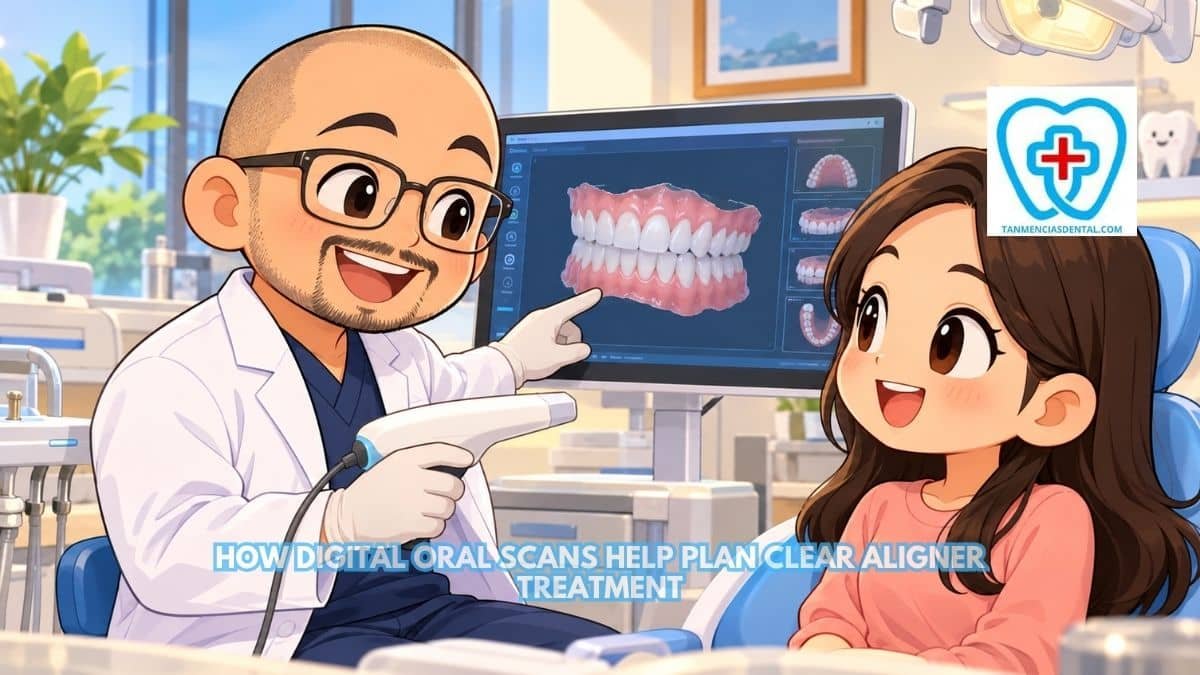
One of the tools commonly used in modern clear aligner treatment is a digital oral scan, also known as an intraoral scan. Instead of using trays filled with impression material to make a physical mold of your teeth, a dentist can use a handheld intraoral scanner to capture the visible surfaces of your teeth and surrounding oral structures.
Specialized software combines this information to create a three-dimensional (3D) digital model of your teeth. This model can then be used to assess your current tooth positions, take measurements, plan proposed tooth movements, and help design your clear aligners.
Digital scanning can make treatment planning more efficient and easier for patients to visualize. However, the scan is only one part of a proper orthodontic assessment. Your dentist still needs to evaluate your oral health, bite, treatment goals, and other diagnostic information before determining whether clear aligners are appropriate for you.
Key Takeaways
- Digital oral scans create a 3D model of the visible surfaces of your teeth that can be used in clear aligner treatment planning.
- Scanning is generally quick and comfortable and avoids the trays of impression material required for conventional dental impressions.
- Digital models help dentists evaluate tooth positions, crowding, spacing, and bite relationships and plan proposed tooth movements.
- Treatment-planning software can show a simulation of the intended tooth movements and proposed outcome, making the treatment easier to understand.
- A digital simulation is a treatment plan, not a guarantee. Teeth may not move exactly as predicted, and additional aligners or other treatment adjustments may sometimes be necessary.
- Digital scans don’t replace a complete dental or orthodontic assessment. Clinical examination, photographs, X-rays, and other diagnostic records may also be needed depending on the patient and treatment plan.
What Is a Digital Oral Scan?
A digital oral scan is essentially a digital impression of your mouth.
During the procedure, your dentist or another appropriately trained member of the dental team moves a small scanning wand around your teeth. The device captures the surfaces of your teeth from multiple angles, and software combines this information into a detailed 3D model.
The completed model can usually be rotated, enlarged, and examined on a computer screen. Your dental team can use it to take measurements and evaluate your teeth from different perspectives.
Digital scanning is now used for a variety of dental procedures, including orthodontic treatment, crowns, bridges, retainers, and other dental appliances.
For clear aligner treatment specifically, the scan provides the digital model from which treatment planning and aligner design can begin.
🦷 Digital Oral Scans vs. Traditional Dental Impressions: What’s the Difference?
Why Accurate Records Matter for Clear Aligner Treatment
Clear aligners work by applying controlled forces to your teeth through a sequence of custom-made trays. As you progress from one aligner to the next, selected teeth are gradually guided toward their planned positions.
Before these movements can be planned, your dentist needs an accurate record of where your teeth are starting.
A digital scan can provide information about:
- The visible shape and position of individual teeth
- Crowding and spacing
- Dental arch form
- Tooth rotations
- Overbite and overjet
- How the upper and lower teeth fit together
- Areas where space may need to be created or maintained
This makes the digital model an important part of treatment planning.
However, an intraoral scan only provides certain types of information. It does not show everything your dentist may need to evaluate.
For example, an optical scan does not provide the same information about tooth roots, supporting bone, impacted teeth, or other structures beneath the gums that dental X-rays can provide. That’s why additional diagnostic records may be recommended before or during orthodontic treatment.
🦷 What Is a Digital Oral Scan? A Patient’s Guide to Your Appointment
How Digital Scans Help Plan Clear Aligner Treatment
1. They Create a Detailed Starting Model
Before planning where your teeth should move, your dentist needs to understand their current positions.
The 3D model created from an intraoral scan allows the dental team to examine your teeth from multiple angles and take digital measurements without relying solely on a physical model.
Modern digital scanning can provide clinically useful accuracy for orthodontic treatment planning and clear aligner fabrication.
Having this digital starting point also makes it possible to compare your progress with your original records later in treatment.
2. They Help Evaluate Crowding and Spacing
If your teeth overlap because there isn’t enough room in the dental arch, your dentist needs to determine how much space is required to improve their alignment.
Likewise, existing gaps between teeth need to be measured and incorporated into the treatment plan.
Digital models can help your dentist evaluate these spaces and consider different ways of managing them.
Depending on your individual case, treatment may involve moving teeth into available space, changing their positions within the dental arch, or creating a small amount of additional space.
One possible technique is interproximal reduction (IPR), in which a carefully controlled amount of enamel is removed between selected teeth. IPR isn’t necessary for every clear aligner patient and should only be performed when clinically appropriate.
3. They Allow Proposed Tooth Movements to Be Planned Digitally
One of the major advantages of a digital workflow is the ability to create a virtual treatment setup.
Using specialized software, your dentist can plan how individual teeth are intended to move over the course of treatment.
The software may help evaluate factors such as:
- Tooth alignment
- Rotations
- Crowding and spacing
- Overbite and overjet
- Proposed arch changes
- Space requirements
- The potential need for IPR
- The proposed final relationship between the upper and lower teeth
This allows the treatment plan to be reviewed digitally before the aligners are produced.
However, software doesn’t replace clinical judgment. The proposed setup needs to be reviewed by the treating dentist and considered alongside your clinical examination and diagnostic records.
4. They Help Plan the Sequence of Treatment
Clear aligner treatment isn’t simply about deciding where each tooth should eventually end up. The sequence in which the teeth move also matters.
Some movements may need to occur before others. Space may need to be created before a crowded tooth can be aligned, for example.
Treatment-planning software allows the clinician to organize proposed tooth movements across a series of stages.
These stages help form the basis for the sequence of aligners you will wear during treatment.
5. They Can Help Plan Attachments and Other Treatment Features
Clear aligners sometimes need additional features to help produce certain tooth movements.
Your dentist may recommend small, tooth-colored pieces of composite material known as attachments. These are temporarily bonded to selected teeth and provide additional surfaces for the aligner to engage.
Depending on the case, treatment may also involve IPR, elastics, or other orthodontic techniques.
The digital treatment plan can help determine where some of these features may be useful.
However, the software-generated plan should still be reviewed and modified by the treating clinician when necessary. The appropriate approach depends on your bite, tooth positions, oral health, treatment objectives, and other individual factors.
6. They Help You Visualize the Proposed Result
For patients, one of the most interesting parts of digital clear aligner planning is the ability to see a simulation of the intended treatment.
Instead of simply being told that certain teeth need to rotate or move, you may be able to see a digital representation of the proposed changes.
This can make your treatment plan easier to understand and help your dentist explain what the aligners are intended to accomplish.
There is one important limitation, though:
The digital simulation shows the planned result. It does not guarantee your final result.
Orthodontic tooth movement is a biological process. Teeth don’t always respond exactly as predicted by treatment-planning software, and some movements can be more challenging to achieve predictably than others.
This is why your progress needs to be monitored throughout treatment.
🦷 Can You Brush Your Teeth After a Filling? What You Need to Know
Digital Scans vs. Traditional Dental Impressions
If you’ve had conventional dental impressions before, you may remember biting into trays containing soft impression material and waiting for it to set.
Digital scanning offers a different experience.
Instead of filling a tray with impression material, the dental team moves an intraoral scanner around your teeth while the system records their surfaces.
For many patients, this can be more comfortable, especially for people who dislike impression material or have a sensitive gag reflex.
Digital scanning also offers practical advantages. The resulting model is already digital, so it can be evaluated, measured, stored, and incorporated into a digital treatment-planning workflow.
Digital scanning can provide clinically useful accuracy for orthodontic purposes, although the quality of a scan can depend on factors such as the equipment, scanning technique, operator experience, and clinical situation.
🦷 How Often Should You Visit the Dentist? Building a Dental Care Plan for Long-Term Oral Health
Does a Digital Oral Scan Use Radiation?
No. The intraoral scanning process itself does not use ionizing radiation like a dental X-ray does.
This is an important distinction.
An intraoral scanner records the visible surfaces of your teeth and surrounding structures to create a 3D digital model. Dental radiographs provide different information, including information about structures that cannot be adequately evaluated from a surface scan alone.
For this reason, having a digital scan doesn’t necessarily mean that X-rays won’t be needed.
Depending on your clinical situation, your dentist may recommend appropriate dental radiographs as part of the diagnostic process. These may include panoramic or cephalometric radiographs. Cone-beam computed tomography (CBCT) may also be considered for selected cases when clinically justified.
In the Philippines, dental X-ray facilities and radiation-emitting equipment are subject to regulatory requirements. Any radiographic examination should be performed using appropriate equipment and in accordance with applicable professional and radiation-safety standards.
🦷 Mouth Peels After Brushing Teeth: Why It Happens and What You Can Do
Can Your Teeth Be Scanned Again During Treatment?
Yes.
Your first scan doesn’t necessarily have to be your last.
Your dentist may recommend another digital scan if your teeth aren’t moving as expected, if the treatment plan needs to be modified, or if additional aligners are needed.
The new scan records the current positions of your teeth. This allows your dentist to reassess your progress and, when appropriate, create an updated digital treatment plan.
Digital scans can therefore be useful not only at the beginning of clear aligner treatment but also when evaluating progress and planning additional treatment.
🦷 Beyond the Dental Checkup: Benefits of an Advanced Dental Health Program
What Are Refinement Aligners?
You may hear the term refinement during clear aligner treatment.
Refinement aligners are additional aligners that may be prescribed when further tooth movement or bite correction is needed after an initial series of aligners.
For example, most of your teeth may have responded well to treatment while one or more haven’t reached their intended positions. In that situation, your dentist may perform another scan and develop an updated plan based on where your teeth are now.
Needing additional aligners doesn’t necessarily mean that the original treatment was unsuccessful. Orthodontic tooth movement involves biological responses, and actual tooth movement can sometimes differ from what was digitally planned.
Refinement requirements can be influenced by several factors, including the complexity and type of tooth movements being attempted.
That’s one reason regular professional monitoring remains an important part of clear aligner treatment.
🦷 Can You Die From a Tooth Abscess? Understanding the Risks and Symptoms
Digital Scans Don’t Replace Your Dentist
With sophisticated scanners and treatment-planning software now available, it’s easy to assume that the computer does most of the treatment planning.
But technology is a tool, not a substitute for professional diagnosis and clinical judgment.
A digital scan can provide a detailed model of the visible portions of your teeth. Software can perform measurements, arrange virtual teeth, and simulate proposed movements.
What the software cannot do on its own is provide a complete clinical assessment of your oral health and determine whether a particular treatment plan is safe and appropriate for you.
Your dentist needs to consider factors such as your:
- Teeth and bite
- Gum and periodontal health
- Dental history
- Existing restorations
- Jaw and skeletal relationships when relevant
- Radiographic findings when indicated
- Treatment goals
- Ability to follow the prescribed aligner-wear schedule
Additional records may include facial and intraoral photographs and appropriate dental X-rays. In selected cases, other diagnostic procedures may also be indicated.
In the Philippines, the correction of tooth malpositions is part of the regulated practice of dentistry. Clear aligner treatment should therefore involve appropriate evaluation and supervision by a dentist who is duly licensed to practice in the Philippines.
🦷 Healthy Gums, Healthy Smile: Why Gum Care Should Be Part of Your Dental Health Program
What to Expect During a Digital Oral Scan
The scanning process is generally straightforward.
You’ll usually be asked to open your mouth while a small scanning wand is moved around your upper and lower teeth. The operator systematically captures the different surfaces until enough information has been recorded to build the 3D model.
Your bite may also be recorded digitally so the software can relate the upper and lower dental arches.
One practical advantage is that the dental team can usually inspect the scan on screen as it is being taken. If an area hasn’t been captured clearly enough, that section can often be rescanned immediately.
Once the scan is complete, the digital model can become part of your dental records and clear aligner treatment-planning workflow.
🦷 Digital Oral Scan in Marikina
🦷 Quality Dental Care You Can Trust in Marikina
The Bottom Line
Digital oral scanning has become a valuable part of modern clear aligner treatment.
By creating a detailed 3D representation of the visible surfaces and positions of your teeth, an intraoral scan gives your dentist a digital starting point for evaluating alignment, crowding, spacing, bite relationships, and proposed tooth movements.
It can also make the treatment process easier for you to understand because you may be able to see a simulation of how your teeth are intended to move.
But the technology has limits.
A scan cannot replace a complete clinical examination, and a digital treatment simulation cannot guarantee that your teeth will move exactly as shown. Orthodontic treatment involves biological processes, individual anatomy, patient cooperation, and ongoing clinical decisions.
That’s why the most important part of clear aligner treatment isn’t simply the scanner or the software.
It’s how your dentist uses the available information to diagnose, plan, monitor, and adjust your treatment appropriately.
Frequently Asked Questions
Are digital oral scans accurate enough for clear aligner treatment?
Modern intraoral scanners can produce digital models with clinically useful accuracy for orthodontic treatment planning and clear aligner fabrication. However, scan quality can depend on the equipment, scanning technique, operator experience, and individual clinical situation.
Does a digital oral scan hurt?
Digital scanning is generally non-invasive and shouldn’t be painful. A small scanning wand is moved around your teeth without needles or drilling. You may need to keep your mouth open for several minutes, but many patients find digital scanning more comfortable than conventional impressions.
Does a digital oral scan expose me to radiation?
No. Optical intraoral scanning itself doesn’t use ionizing radiation. Dental X-rays are a separate diagnostic procedure and may still be recommended when clinically appropriate.
Can a digital scan show my tooth roots?
Not in the same way a dental X-ray or CBCT can. A standard optical intraoral scan primarily records visible surfaces. If information about tooth roots, supporting bone, impacted teeth, or other structures below the gums is needed, your dentist may recommend appropriate radiographic imaging.
Can a digital scan show exactly what my teeth will look like after treatment?
It can be used to create a simulation of the planned result, but this isn’t a guarantee of your final appearance or tooth positions. Actual tooth movement may differ from the digital plan.
Why might I need another scan during treatment?
Another scan may be recommended if your teeth aren’t tracking according to plan, if your dentist needs to modify the treatment, or if additional aligners are required.
Do digital scans replace dental X-rays?
No. They provide different information. A digital oral scan records visible surfaces and tooth positions, while dental X-rays can provide information about tooth roots, bone, impacted teeth, and other structures that aren’t visible on a surface scan.
Can a digital scan determine whether I’m a good candidate for clear aligners?
A scan can provide important information, but it cannot make that determination by itself. Your dentist will also need to consider your bite, oral and periodontal health, treatment needs, diagnostic records, and other clinical factors.
Will I definitely need refinement aligners?
Not necessarily. Some patients may complete treatment with the initially planned series, while others need additional aligners. This can depend on the complexity of treatment, the tooth movements required, how your teeth respond, and how consistently the aligners are worn.
How long does a digital oral scan take?
The exact time varies depending on the scanner, operator, and complexity of the mouth being scanned. In general, intraoral scanning is designed to be relatively quick, and additional areas can often be rescanned immediately if needed.
Are clear aligners suitable for everyone?
No. Clear aligners can treat many orthodontic problems, but they may not be the best option for every patient or every type of tooth movement. A dentist needs to assess your teeth, gums, bite, and treatment goals before recommending the most appropriate orthodontic approach.
Ready to Learn More About Clear Aligners?
If you’re interested in clear aligners and digital oral scanning, visit Tan-Mencias Dental Clinic at 44 G. Del Pilar Street, Parang, Marikina City. Our dental team can check your teeth and help you understand whether clear aligners may be right for you. If you have questions or concerns, you can call our clinic or contact us at 0917-145-1074. You can also send us a message through our Facebook page or use the contact form on our website. We’ll be happy to answer your questions and help you take the next step toward a healthier, more confident smile.
Medical Disclaimer
This article is provided for general educational and informational purposes only. It is not intended to replace professional dental advice, diagnosis, examination, or treatment.
Clear aligner treatment should be planned according to each patient’s individual oral health, tooth and jaw relationships, periodontal condition, dental history, diagnostic findings, and treatment goals. The suitability of digital scans, dental X-rays, clear aligners, attachments, interproximal reduction, and other procedures should be determined by a qualified dental professional after an appropriate clinical assessment.
If you are considering clear aligners or have concerns about your teeth or bite, consult a dentist who is duly licensed to practice in the Philippines for advice specific to your situation.