
If you’ve ever needed a dental crown, bridge, clear aligner, night guard, or another custom dental appliance, your dentist may need an accurate record of the shape and position of your teeth and surrounding oral structures.
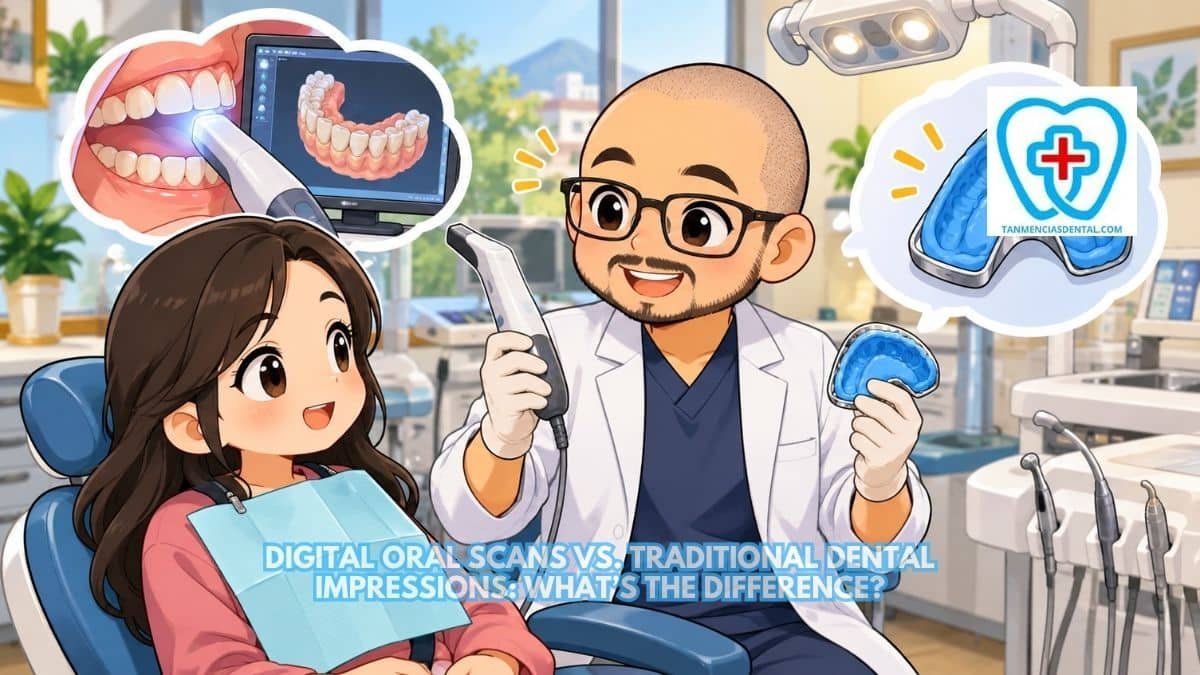
Traditionally, this has been done using a dental impression tray filled with a soft material that sets around your teeth. Today, many dental clinics also use digital oral scanners, also known as intraoral scanners, to create a three-dimensional (3D) digital model of the mouth.
Both digital oral scans (digital impressions) and traditional dental impressions serve a similar purpose: they provide your dentist and, when necessary, a dental laboratory with information needed to plan treatment or fabricate restorations and appliances.
The main difference is how that information is captured and processed.
Digital scanning can make the process faster and more comfortable for many patients while fitting easily into modern digital dental workflows. Traditional impressions, however, remain an established and reliable technique and may still be preferred for certain clinical situations.
Key Takeaways
- Digital oral scans use an intraoral scanner to create a 3D digital model of your teeth and surrounding oral structures.
- Traditional impressions use a tray filled with impression material that sets around the teeth before being removed.
- Digital scanning is often more comfortable, particularly for patients who dislike impression material or have a sensitive gag reflex.
- Digital scans can usually be checked immediately, and an incomplete area can often be rescanned without repeating the entire procedure.
- Digital files can be electronically transferred to compatible dental laboratories and incorporated into computer-aided design and manufacturing (CAD/CAM) workflows.
- Both digital and traditional impressions can provide clinically acceptable results when used appropriately.
- Neither technique is automatically the best option for every patient or dental procedure. Your dentist will consider the treatment being performed, the areas that need to be recorded, and the available clinical and laboratory workflow.
What Is a Digital Oral Scan?
A digital oral scan is essentially a 3D digital impression of your mouth.
Instead of placing a tray filled with impression material over your teeth, your dentist or appropriately trained dental professional uses a small handheld device called an intraoral scanner.
The scanner captures detailed surface information from your teeth and surrounding oral structures. Specialized software processes the captured information and builds a detailed 3D digital model.
In many systems, you can even watch the model of your teeth appear on a computer screen as the scan progresses.
Digital impressions may be used for procedures such as:
- Crowns
- Bridges and other fixed restorations
- Inlays and onlays
- Clear aligners and other orthodontic treatments
- Some implant restorations
- Surgical guides
- Night guards and other occlusal appliances
The exact applications depend on the scanner, software, laboratory workflow, and treatment being planned.
What happens during a digital oral scan?
The process is generally straightforward.
Your dental professional first prepares the area for scanning. Saliva, blood, and other materials may need to be controlled because the scanner needs a sufficiently clear view of the surfaces being recorded.
The scanner tip is then moved systematically around your teeth while the software constructs the 3D model.
One advantage is that the dental professional can usually inspect the digital model immediately. If a particular area hasn’t been recorded clearly, that portion can often be rescanned instead of repeating the entire process.
Once the scan is complete, the digital file can be used for treatment planning or sent electronically to a compatible dental laboratory or other dental service provider when necessary.
🦷 What Is a Digital Oral Scan? A Patient’s Guide to Your Appointment
What Is a Traditional Dental Impression?
A traditional, or conventional, dental impression creates a physical negative reproduction of the teeth and surrounding oral structures.
Your dentist selects an appropriately sized impression tray and places impression material inside it. Different materials may be used depending on the purpose of the impression.
The tray is positioned over your teeth and kept in place while the material sets. Once it has set sufficiently, the tray is removed from your mouth.
The completed impression can then be used to create a physical model or sent to a dental laboratory as part of the process of making a restoration or appliance.
Traditional impressions have been used successfully for decades and remain an important part of dentistry.
🦷 Can You Brush Your Teeth After a Filling? What You Need to Know
Digital Oral Scans vs. Traditional Impressions
Here’s how the two approaches generally compare:
| Feature | Digital Oral Scan | Traditional Impression |
| How it works | Scanner captures surface information to create a 3D digital model | Impression material physically records the teeth and surrounding structures |
| What goes in your mouth | Small scanner tip | Tray filled with impression material |
| Comfort | Often preferred by patients | Can feel bulky or uncomfortable for some patients |
| Gag reflex | May be easier for patients with a sensitive gag reflex | Tray and impression material can sometimes trigger gagging |
| Procedure time | Often faster for suitable cases | Requires placement and setting of impression material |
| Checking the result | Scan can usually be inspected immediately | Impression is evaluated after it is removed |
| Correcting an incomplete area | A specific area can often be rescanned | A defective impression may need to be repeated |
| Storage | Stored as digital data | May involve physical impressions and/or models |
| Laboratory transfer | Can be transmitted electronically to compatible laboratories | Physical impression or model may need to be transported |
| Accuracy | Clinically acceptable for many applications | Established and reliable when performed correctly |
| Best use | Particularly useful in digital restorative and orthodontic workflows | Remains useful for many conventional and certain complex workflows |
🦷 How Often Should You Visit the Dentist? Building a Dental Care Plan for Long-Term Oral Health
Which Is More Comfortable?
For many patients, this is one of the most noticeable differences.
Traditional impressions require you to keep a tray containing impression material in your mouth while the material sets. Some patients tolerate this without difficulty, while others dislike the pressure, taste, feeling of fullness, or urge to gag.
An intraoral scanner doesn’t require a tray full of impression material. The scanner still needs to move around the mouth, and certain areas may feel slightly awkward to reach, but many patients find the process easier to tolerate.
Research comparing digital and conventional impressions has generally found greater patient preference and comfort with digital scanning.
If you have a strong gag reflex or have had difficulty with traditional impressions in the past, tell your dentist before the procedure.
🦷 Mouth Peels After Brushing Teeth: Why It Happens and What You Can Do
Which Method Is Faster?
Digital scanning can often reduce chairside time, although this depends on the procedure, equipment, and experience of the dental professional.
With a traditional impression, the material must be prepared or dispensed, placed in the mouth, allowed to set, removed, and inspected. If an important part of the impression is defective, another impression may be necessary.
With digital scanning, the dental professional can see the developing model on the screen and may be able to correct an incomplete area immediately.
The digital file can also be transferred electronically to a compatible dental laboratory, eliminating some physical handling and transportation steps.
However, scanning time varies depending on the number of teeth being recorded, the clinical situation, the scanner being used, and the operator’s experience.
🦷 Beyond the Dental Checkup: Benefits of an Advanced Dental Health Program
Which Is More Accurate?
This is where comparisons need some context.
You may hear that digital impressions are “more accurate” than traditional impressions, but the evidence doesn’t support making that statement for every dental procedure.
Both methods can produce clinically acceptable results when they are used correctly.
Accuracy can be influenced by factors such as:
- The number of teeth or implants being recorded
- Whether a small area or complete dental arch is being scanned
- The scanner and software being used
- The type of traditional impression material
- Moisture and soft-tissue management
- The location of restoration margins
- The clinical situation
- The experience and technique of the operator
- The type of restoration or appliance being made
Digital scanning performs very well for many common applications, including numerous single-tooth and short-span restorative procedures.
Complete-arch and complex cases can be more challenging, although intraoral scanning technology continues to develop.
Instead of asking whether digital or traditional impressions are universally more accurate, a more useful question is:
Which impression technique is most appropriate for my particular treatment?
Your dentist is in the best position to answer that after evaluating your mouth and the planned procedure.
🦷 Can You Die From a Tooth Abscess? Understanding the Risks and Symptoms
Advantages of Digital Oral Scanning
Digital scanning offers several potential advantages for both patients and dental professionals.
1. Greater patient comfort
For many people, eliminating the tray and impression material makes the procedure more comfortable.
This can be especially helpful if you have previously experienced gagging or anxiety during conventional dental impressions.
2. Immediate visualization
The dental professional can usually examine the 3D model immediately.
Digital models can also help your dentist explain certain aspects of your teeth or proposed treatment by allowing you to see a detailed representation of your mouth on a screen.
3. Easier corrections
If a small part of the scan is incomplete, the affected area can often be rescanned.
With conventional impressions, a significant defect may require a new impression.
4. Efficient digital workflow
Digital scan files can be incorporated into CAD/CAM and other digital dental workflows.
When compatible systems are being used, the file can also be sent electronically to a dental laboratory, potentially streamlining the process of designing and manufacturing a restoration or appliance.
5. Less physical storage
Digital models don’t require the same physical storage space as conventional impressions and stone models.
6. Ability to compare digital records
When clinically appropriate, digital models taken at different times may be compared to help dental professionals evaluate changes in tooth position, tooth wear, or other visible oral structures.
🦷 Healthy Gums, Healthy Smile: Why Gum Care Should Be Part of Your Dental Health Program
Potential Disadvantages of Digital Scanning
Digital technology has limitations too.
Intraoral scanners are sophisticated devices, and obtaining a high-quality scan requires proper technique and training.
Saliva, blood, mobile soft tissues, limited access, and difficult-to-see areas can make scanning more challenging. Some extensive restorative, implant, or prosthodontic cases may also require additional techniques or a conventional impression.
There is also a significant investment for dental clinics. Intraoral scanners require equipment, software, maintenance, and staff training.
Digital scans also need to be handled securely
A digital dental scan forms part of a patient’s dental information and may be stored or transferred electronically.
For dental clinics in the Philippines, patient health information is considered sensitive personal information under the Data Privacy Act of 2012 (Republic Act No. 10173). Clinics therefore need appropriate measures for the collection, processing, storage, access, and transfer of patient information.
For patients, this means digital convenience should also be accompanied by appropriate privacy and data-security practices.
🦷 What Ages Do Pediatric Dentists Treat? A Guide for Parents
Advantages of Traditional Dental Impressions
Conventional impressions remain useful and shouldn’t automatically be viewed as outdated.
Dentists and dental laboratories have decades of experience working with traditional impression techniques and materials. When performed correctly, conventional impressions can provide reliable records for many types of dental treatment.
They may also be useful when certain areas are difficult to capture digitally or when the planned treatment or laboratory workflow is better suited to a physical impression.
🦷 Digital Oral Scan in Marikina
Disadvantages of Traditional Impressions
Patient comfort is one of the most common drawbacks.
The impression tray can feel bulky, and some patients experience gagging or discomfort while the material sets.
There are also several physical steps in the process. Movement, bubbles, inadequate material coverage, distortion, moisture contamination, or other procedural issues can affect the quality of an impression.
If an important area hasn’t been recorded adequately, the impression may need to be repeated.
Physical impressions and models can also require storage, handling, and transportation.
🦷 Dependable Dentists in Marikina City
When Might a Dentist Prefer a Digital Scan?
Digital scanning can be particularly useful when treatment integrates easily with digital design and manufacturing.
Depending on the clinical situation and equipment available, your dentist may use digital impressions for:
- Crowns
- Certain bridges
- Inlays and onlays
- Clear aligner treatment
- Night guards
- Some implant restorations
- Surgical guides
- Other digitally designed dental appliances
Digital scanning may also be particularly appealing for patients who have struggled with conventional impressions.
However, not every dental clinic in the Philippines uses the same equipment or laboratory workflow. The availability of intraoral scanning can vary between practices, and the method chosen should ultimately be based on clinical needs rather than technology alone.
When Might a Traditional Impression Be Preferred?
A conventional impression may be preferred when the dental professional needs to record an area that is difficult to capture reliably with an intraoral scanner or when the restoration or laboratory process is better suited to a traditional workflow.
Certain extensive restorative, complete-arch, removable prosthodontic, and complex implant cases may require conventional impressions, digital techniques, or a combination of both.
Technology in this area continues to advance, so the appropriate method can also change as scanners, software, materials, and clinical techniques improve.
The important point is that digital and traditional impressions aren’t necessarily competing technologies. They are tools that your dentist can select according to the requirements of your treatment.
Do Digital Oral Scans Replace Dental X-Rays?
No.
This is an important distinction.
An intraoral scanner primarily records the visible surface anatomy of your teeth and surrounding oral structures. It can create an extremely detailed 3D model, but it doesn’t provide the same diagnostic information as a dental X-ray.
X-rays can reveal structures that aren’t visible to an optical scanner, including areas inside and between teeth and structures beneath the gums and within the jawbone.
Depending on your dental needs, your dentist may recommend both a digital oral scan and dental X-rays because they provide different types of information.
Digital vs. Traditional Impressions: Which Should You Choose?
In many cases, you won’t need to make this decision on your own.
Your dentist will consider the treatment you’re receiving, your oral condition, the accuracy required, the technology available at the clinic, and the workflow of the dental laboratory involved.
For many routine applications, digital scanning offers an attractive combination of comfort, efficiency, immediate visualization, and integration with modern dental technology.
But traditional impressions haven’t become obsolete. They remain an established and useful technique and may be the more appropriate option in certain situations.
The goal isn’t simply to use the newest technology. The goal is to obtain an accurate record that allows your dental team to plan and provide your treatment properly.
Frequently Asked Questions
Are digital dental scans more accurate than traditional impressions?
Not necessarily in every situation. Digital scans can provide excellent accuracy for many dental applications, while conventional impressions remain reliable when performed correctly.
Accuracy depends on the procedure, the area being recorded, the equipment and materials used, and the dental professional’s technique.
Are digital oral scans painful?
A digital oral scan normally shouldn’t be painful. You may feel the scanner moving around your teeth and gums, and accessing certain areas can feel slightly uncomfortable or awkward.
If you experience pain during the procedure, tell your dental professional.
Are digital scans better if I have a strong gag reflex?
They may be more comfortable. Digital scanning doesn’t require a tray filled with impression material to remain in your mouth while it sets, which may make the experience easier for people with a sensitive gag reflex.
How long does a digital dental scan take?
There isn’t one standard scanning time. It depends on how much of the mouth needs to be recorded, the scanner being used, the complexity of the case, and the operator’s experience.
For many suitable procedures, digital scanning can be faster than taking a conventional impression.
Do digital oral scans expose me to radiation?
Intraoral scanners used for digital impressions capture surface information using optical scanning technology; they aren’t the same as dental X-ray equipment.
Your dentist may still recommend X-rays separately when diagnostic imaging is necessary.
Can digital scans be used for dental crowns?
Yes. Dental crowns are a common application for intraoral scanners. Depending on the clinic and laboratory workflow, the digital impression can be used to help design and manufacture the final restoration.
Can digital scans be used for clear aligners?
Yes. Digital scans can be used to create 3D models of the teeth for orthodontic assessment, treatment planning, and compatible clear-aligner systems.
Can digital scans be used for dentures?
They can be used in some denture workflows, but suitability varies. Recording an edentulous mouth and movable soft tissues can present different challenges from scanning natural teeth.
Depending on your case, your dentist may use digital scanning, conventional impressions, or a combination of techniques.
Are my digital dental scans kept private?
Digital dental scans and related patient information should be handled as confidential health information. In the Philippines, health information is considered sensitive personal information under the Data Privacy Act of 2012.
Dental clinics should have appropriate procedures for protecting patient information when it is collected, stored, accessed, or shared with authorized third parties such as dental laboratories.
Will traditional dental impressions eventually disappear?
It’s difficult to predict, but conventional impressions remain clinically useful even as digital dentistry becomes more widely adopted.
Rather than completely replacing one another, digital and conventional techniques can complement each other. Your dentist can select the method, or combination of methods, that best suits your treatment.
The Bottom Line
Digital oral scans and traditional dental impressions are two methods of achieving essentially the same goal: creating an accurate representation of your teeth and surrounding oral structures for dental treatment.
Digital scanning replaces impression trays and setting materials with a handheld intraoral scanner that creates a 3D digital model. For many patients and procedures, this can mean a more comfortable and efficient experience, while giving the dental team immediate access to the resulting model.
Traditional impressions remain an established, reliable, and useful technique, particularly when a particular clinical situation or laboratory workflow calls for them.
So, if your dentist recommends a digital scan, you’re experiencing one of the practical applications of modern digital dentistry. And if your dentist recommends a traditional impression instead, it doesn’t necessarily mean you’re receiving outdated care.
The right technique is the one that allows your dental team to obtain the information they need to provide appropriate treatment for your individual case.
Ask Us About Digital Dental Scans
If you have questions about digital dental scans or traditional impressions, the team at Tan-Mencias Dental Clinic is here to help. Visit us at 44 G. Del Pilar Street, Parang, Marikina City, and talk to us about your dental needs. You can call our clinic or reach us at 0917-145-1074 if you have any questions or concerns. You can also send us a message through our Facebook page or our website’s contact form. We’ll be happy to answer your questions and help you understand which dental options may be right for you.
Medical Disclaimer
This article is provided for general educational and informational purposes only and should not be considered a substitute for professional dental or medical advice, diagnosis, or treatment. The suitability of digital oral scanning, conventional dental impressions, dental X-rays, or any other dental procedure depends on the individual patient and the treatment being considered.
If you have questions or concerns about your oral health or dental treatment, consult a dentist licensed to practice in the Philippines or another appropriately qualified healthcare professional. Do not delay or disregard professional advice because of information you have read on this website.