
If your dentist tells you that you need a digital oral scan, you may wonder what exactly that involves. Will it hurt? Does it use radiation? How long will you have to sit still? And why does your dentist need a 3D model of your teeth in the first place?
A digital oral scan, also commonly called an intraoral scan or digital dental impression, is a noninvasive way of creating a detailed digital model of your teeth and other visible structures inside your mouth.
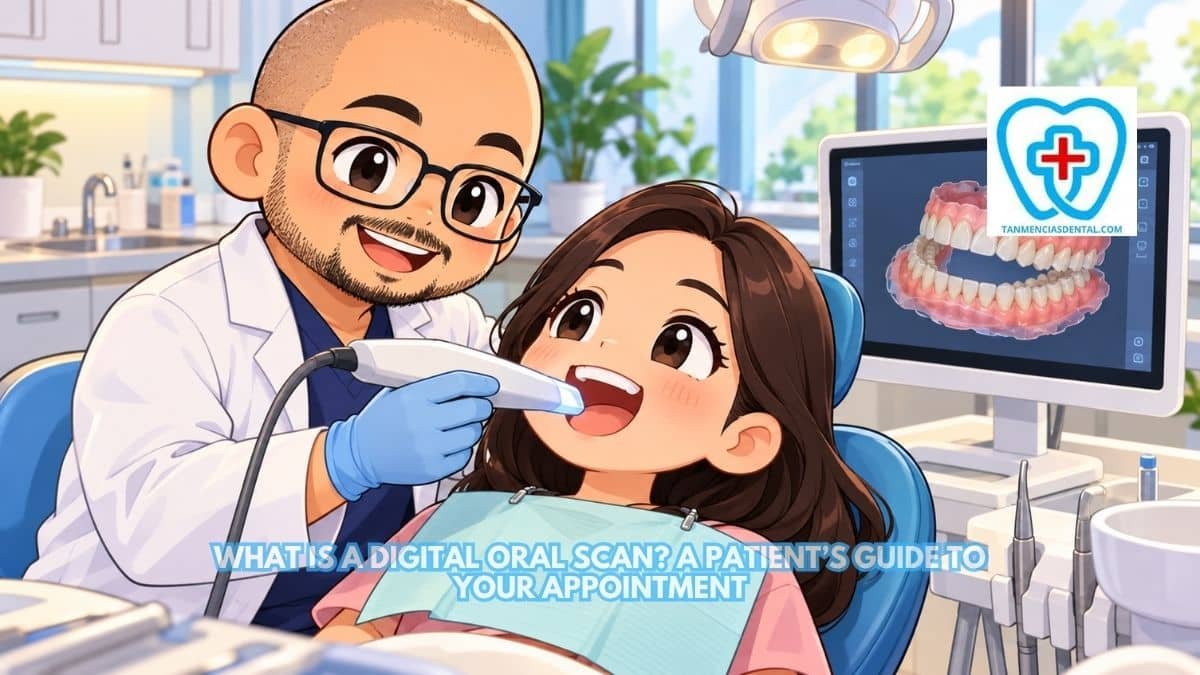
Instead of placing a tray filled with impression material over your teeth, your dental professional uses a small handheld device called an intraoral scanner. As the scanner is moved around your mouth, it captures information about the surfaces of your teeth and gums. Computer software then combines this information to create a three-dimensional model.
Digital scans can be used for many types of dental and orthodontic treatment, including crowns, bridges, clear aligners, retainers, mouth guards, and certain implant-related procedures.
If you have a digital scan coming up, here’s what you can generally expect.
Key Takeaways
- A digital oral scan uses an intraoral scanner to create a 3D digital representation of your teeth and other visible oral structures.
- Digital scanning can replace conventional dental impressions for many, but not all, procedures.
- The scan itself is noninvasive and generally painless, although keeping your mouth open or having the scanner near the back teeth may cause temporary discomfort.
- Standard optical intraoral scanning does not use the ionizing radiation used in dental X-rays or CBCT scans.
- Digital scans can be used when planning crowns, bridges, clear aligners, retainers, mouth guards, and certain implant treatments.
- Many patients find digital scanning more comfortable than conventional impressions, particularly if they have a sensitive gag reflex.
- The suitability of digital scanning depends on the treatment, the condition of your mouth, the scanner being used, and your dentist’s clinical judgment.
What Is a Digital Oral Scan?
A digital oral scan records the shape and surface details of your teeth, gums, and other structures that the scanner can see inside your mouth.
Your dental professional uses a handheld intraoral scanner and moves it systematically around your teeth. The device captures optical information from the surfaces being scanned, while specialized software processes the data to construct a virtual 3D model.
Think of it as creating a detailed digital model of your mouth instead of making a physical mold with conventional impression material.
Once created, the model can usually be viewed from different angles and enlarged on a computer screen. Depending on the treatment and equipment being used, the digital file can also be incorporated into computer-aided design and manufacturing workflows or securely shared with a dental laboratory.
🦷 Can You Brush Your Teeth After a Filling? What You Need to Know
Why Would I Need a Digital Oral Scan?
Intraoral scanners have several uses in modern dentistry. Your dentist may recommend a digital scan when planning or providing treatment such as:
- Crowns, inlays, and onlays
- Bridges
- Veneers
- Clear aligners and other orthodontic treatment
- Retainers
- Mouth guards and other dental appliances
- Certain types of dentures
- Dental implant restorations
- Surgical guides
- Cosmetic dental treatment
- Monitoring changes in the teeth or bite
The purpose of the scan depends on your treatment.
For example, if you’re getting a crown, a scan may record the prepared tooth and surrounding teeth so that a restoration can be designed to fit your mouth.
For orthodontic treatment, a digital model can help your dentist or orthodontist assess tooth position, plan treatment, and, when appropriate, design clear aligners or other appliances.
🦷 How Often Should You Visit the Dentist? Building a Dental Care Plan for Long-Term Oral Health
What Happens During a Digital Oral Scan?
The procedure is usually straightforward.
You’ll sit or recline in the dental chair much as you would during a regular dental examination. Your dental professional may first make sure the surfaces that need to be scanned are sufficiently clean and dry.
The scanner wand is then placed inside your mouth and moved over your teeth in a specific sequence. Depending on what your dentist needs, the scanner may capture the biting surfaces as well as the front and back surfaces of your teeth and portions of your gums.
As the scanner moves, you may be able to see the digital model developing on a computer screen.
You may be asked to:
- Open your mouth wider
- Turn your head slightly
- Move your tongue out of the way
- Bite your teeth together for a bite scan
- Remain still briefly while a particular area is captured
If part of the scan is incomplete or unclear, your dental professional can often rescan that specific area instead of repeating the entire impression.
🦷 Mouth Peels After Brushing Teeth: Why It Happens and What You Can Do
How Long Does a Digital Oral Scan Take?
There isn’t one standard scanning time.
How long your scan takes depends on factors such as the number of teeth or arches being scanned, the type of scanner, the purpose of the scan, conditions inside your mouth, and the experience of the operator.
Scanning a small area can be relatively quick, while capturing both full dental arches and your bite will generally take longer.
Your total appointment may also include an examination, photographs, X-rays when clinically indicated, tooth preparation, treatment planning, or other procedures. So, the amount of time you’re booked at the clinic isn’t necessarily the amount of time the scanner will be inside your mouth.
🦷 Beyond the Dental Checkup: Benefits of an Advanced Dental Health Program
Does a Digital Oral Scan Hurt?
For most patients, the scan itself should not be painful.
There are no injections, incisions, or drilling involved in the scanning process itself. The scanner is simply moved around the surfaces inside your mouth.
However, you may experience some temporary discomfort. For example, keeping your mouth open for several minutes can become tiring. You may also feel the scanner or your dental professional gently moving your cheek or tongue out of the way.
If you have a sensitive gag reflex, scanning the back teeth may feel uncomfortable.
Tell your dental professional if you need a break. One advantage of digital scanning is that the procedure can generally be paused and resumed.
🦷 Can You Die From a Tooth Abscess? Understanding the Risks and Symptoms
Is a Digital Scan More Comfortable Than a Traditional Impression?
For many patients, yes.
Traditional dental impressions usually involve placing impression material in a tray, positioning it over your teeth, and leaving it in place while the material sets. Some people dislike the taste, pressure, fullness, or gagging sensation associated with this process.
Studies comparing patient experiences have generally found that patients tend to prefer intraoral scanning and report less discomfort than with conventional impression techniques.
That doesn’t mean conventional impressions are obsolete, however. They remain useful and may be preferable or necessary in certain clinical situations.
🦷 Healthy Gums, Healthy Smile: Why Gum Care Should Be Part of Your Dental Health Program
Does a Digital Oral Scan Use Radiation?
A standard optical intraoral scan does not use the ionizing radiation associated with dental X-rays.
This is an important distinction because several different technologies may be used during a dental appointment.
An intraoral scanner primarily records the visible surfaces of your teeth and surrounding oral structures. Dental X-rays, on the other hand, use ionizing radiation to provide information about structures that cannot be adequately assessed just by looking at the surface.
A cone-beam computed tomography (CBCT) scan is different again. CBCT uses X-rays to create three-dimensional images of teeth, jaws, bone, and other structures in the head and face.
In the Philippines, facilities operating dental X-ray equipment are subject to applicable radiation-safety and regulatory requirements.
Your dentist may recommend both an intraoral scan and dental X-rays or CBCT because these technologies provide different types of information. An intraoral scan does not automatically replace diagnostic radiographs when they are clinically necessary.
🦷 What Ages Do Pediatric Dentists Treat? A Guide for Parents
Digital Oral Scan vs. Traditional Dental Impressions
Both methods can be used to record the shape of your teeth and surrounding oral structures, but they work differently.
With a conventional impression, dental impression material is placed into a tray, which is positioned over your teeth. After the material sets, the impression is removed and can be used to produce a physical model.
With a digital impression, an intraoral scanner captures the required surfaces and creates the model electronically.
Digital scanning offers several potential advantages. There’s no tray full of impression material; the digital model can be inspected immediately, and incomplete areas can often be rescanned without repeating the entire procedure. Digital files can also be integrated into dental laboratory and computer-aided design workflows.
However, digital isn’t automatically better in every situation.
Accuracy varies depending on the scanner, scanning technique, size and type of area being scanned, moisture control, oral anatomy, and the specific treatment. Certain full-arch, completely edentulous, and complex implant situations can present additional challenges for intraoral scanners.
Your dentist will decide which impression technique is appropriate based on your individual case.
🦷 Prevent Dental Problems Before They Start: How an Advanced Dental Health Program Protects Your Smile
What Are the Benefits of a Digital Oral Scan?
It Can Be More Comfortable
For many patients, eliminating trays filled with impression material makes the process easier, especially for people with a sensitive gag reflex.
You Can See the 3D Model
One of the most patient-friendly features of digital scanning is the ability to see your teeth on a screen.
Your dentist may rotate or enlarge the model while explaining your treatment. This can make certain dental issues and proposed treatments easier to understand.
Areas Can Often Be Rescanned
If a section of the digital impression isn’t clear enough, the dental professional can often collect additional information from that area rather than repeating the entire scan.
Digital Files Can Support an Efficient Workflow
Depending on the system being used, scans can be securely transferred electronically to a dental laboratory or incorporated into digital treatment-planning and manufacturing workflows.
Scans Can Be Stored Digitally
Digital models can be stored as part of the clinic’s digital records, subject to the clinic’s record-management and data-protection practices. When appropriate, scans taken at different times may also help your dental team evaluate changes in your teeth or bite.
In the Philippines, information relating to a person’s health is considered sensitive personal information under the Data Privacy Act of 2012. Dental clinics that process patient information must therefore handle such data in accordance with applicable privacy requirements.
🦷 Digital Oral Scan in Marikina
How Accurate Are Digital Oral Scans?
Modern intraoral scanners can provide clinically useful and accurate digital impressions for many dental applications.
However, accuracy isn’t determined by the scanner alone. It can be affected by:
- The scanner and software being used
- The size of the area being scanned
- The scanning technique
- Moisture, saliva, or bleeding
- The location and accessibility of the teeth
- Whether natural teeth, implants, or soft tissues are being recorded
- The clinical experience of the operator
Evidence suggests that digital impressions can achieve clinically acceptable accuracy for many applications, but results can vary in more demanding situations. Full-arch implant cases and completely edentulous arches, for example, can present particular challenges because large areas and mobile soft tissues must be recorded accurately.
For patients, the practical takeaway is simple: digital scanning is a valuable clinical tool, but it isn’t automatically the ideal impression method for every case. Your dentist will determine which technique is most appropriate for the treatment you need.
🦷 Trusted Oral Care Providers in Marikina City
How Should I Prepare for My Appointment?
Most digital oral scans require very little preparation from you.
Unless your dental clinic gives you specific instructions, you can generally follow your usual oral hygiene routine before your appointment.
It can also be helpful to tell your dental team beforehand if you:
- Have a strong gag reflex
- Experience dental anxiety
- Have difficulty keeping your mouth open
- Have jaw or temporomandibular joint (TMJ) problems
- Have very sensitive teeth or gums
- Need frequent breaks during dental treatment
Knowing this in advance can help your dental team make the scanning process more comfortable.
What Happens After the Scan?
If the intraoral scan is the only procedure performed, there’s usually no special recovery period.
Because the scan itself doesn’t normally require anesthesia or surgery, you can generally return to your usual activities immediately. Eating and drinking restrictions aren’t typically required solely because you’ve had an intraoral scan.
However, if you received local anesthesia or underwent another dental procedure during the same appointment, follow the specific aftercare instructions provided by your dentist.
What happens to your scan will depend on why it was taken.
Your dentist may use the digital model for treatment planning, send the necessary information to a dental laboratory, compare it with future scans, or use it as part of a digital workflow for creating a restoration or appliance.
Are There Any Risks or Downsides?
Digital oral scanning is noninvasive, but it does have limitations.
Possible issues include:
- Temporary discomfort from keeping your mouth open
- Gagging when scanning the back teeth
- Difficulty scanning areas that are hard to reach
- Interference from saliva, blood, or movement
- Difficulty accurately recording certain mobile soft tissues
- Differences in accuracy between scanners and clinical situations
An intraoral scan primarily records surfaces that the scanner can capture. It cannot replace every part of a dental examination, and it isn’t a substitute for X-rays or other diagnostic imaging when those are necessary.
Your dentist will consider these factors when deciding whether digital scanning is appropriate for you.
Frequently Asked Questions
Is a digital oral scan the same as a dental X-ray?
No. A standard intraoral scanner uses optical technology to capture surface information and does not use the ionizing radiation associated with dental X-rays. X-rays provide different diagnostic information, including information about structures that cannot be adequately evaluated from visible surfaces alone.
Is an intraoral scan the same as a CBCT scan?
No. An intraoral scan captures visible surface details of your teeth and nearby oral structures. CBCT uses X-rays to produce three-dimensional images that can show teeth, jaws, bone, and other anatomical structures. Your dentist may recommend one or both depending on what needs to be evaluated.
Do I need anesthesia for a digital scan?
Usually not. Scanning itself doesn’t normally require local anesthesia. However, you may receive anesthesia if another dental procedure is being performed during the same appointment.
Will the scanner touch my teeth?
It may occasionally make light contact with your teeth or other parts of your mouth as it is moved around, but the scanning process itself should not be painful.
What if I have a strong gag reflex?
Tell your dental team before the scan begins. Many patients with sensitive gag reflexes find digital scanning easier than conventional impressions because there is no large tray filled with impression material that needs to remain in the mouth while it sets.
Can digital scans be used for clear aligners?
Yes. Digital scans are commonly used to create 3D models for orthodontic assessment and clear-aligner treatment planning. Whether clear aligners are appropriate for you requires an individual evaluation by a qualified dental professional.
Can a digital oral scan detect cavities?
An intraoral scan can provide detailed surface information, and some scanner systems include additional imaging or software features that may assist dental professionals in evaluating teeth.
However, a digital oral scan should not be considered a replacement for a comprehensive dental examination or necessary diagnostic X-rays. Cavities can develop in areas that may not be adequately assessed from a surface scan alone, such as between teeth.
How soon can my dentist see the scan?
Usually immediately. The 3D model is generally generated on the computer during the scanning process, allowing your dental professional to inspect it before the appointment is finished.
Can I eat after a digital oral scan?
If you only had an intraoral scan, there are generally no special restrictions on eating or drinking afterward.
If another treatment was performed during the same visit, particularly if you received local anesthesia, follow the instructions given by your dental team.
Are my digital dental scans stored by the clinic?
They may be stored as part of your dental records, depending on the clinic’s systems and the purpose for which the scan was taken. Because identifiable dental and health information is sensitive personal information, Philippine dental clinics must handle patient data in accordance with applicable privacy and data-protection requirements.
If you have questions about how your scan is stored, used, or shared, ask your clinic about its privacy practices.
The Bottom Line
A digital oral scan is essentially a 3D digital impression of your mouth. Instead of relying on a tray filled with impression material, an intraoral scanner captures the visible surfaces of your teeth and surrounding structures and converts that information into a digital model.
For many patients, digital scanning offers a comfortable and convenient alternative to conventional impressions. It can help dentists plan treatment, explain dental conditions, communicate with dental laboratories, and create customized restorations or appliances.
At the same time, digital scanning isn’t the right solution for every dental situation, nor does it replace a complete dental examination or necessary X-rays. The appropriate imaging and impression methods depend on your oral health, the treatment being planned, and your dentist’s clinical assessment.
So, if your dentist says, “We’re going to scan your teeth today,” there’s generally no reason to be concerned. You’ll usually just need to keep your mouth open while a small scanner moves around your teeth, and you may get to see a remarkably detailed 3D model of your smile before you leave the chair.
Visit Tan-Mencias Dental Clinic for Your Dental Care
If you have questions about digital oral scans or your dental health, our team at Tan-Mencias Dental Clinic is here to help. Visit us at 44 G. Del Pilar Street, Parang, Marikina City, and let us help you understand the dental care that may be right for you. For questions or concerns, you can call our clinic or contact us at 0917-145-1074. You can also send us a message through our Facebook page or our website’s contact form. We look forward to helping you feel informed, comfortable, and confident about your next dental visit.
Medical Disclaimer
This article is provided for general educational and informational purposes only. It is not intended to replace professional dental or medical advice, diagnosis, or treatment. Dental procedures, technologies, and treatment recommendations may vary according to the individual patient, clinical circumstances, equipment used, and professional judgment of the treating dentist. If you have questions about your oral health, a digital oral scan, dental X-rays, or any proposed treatment, consult a dentist licensed to practice in the Philippines or another appropriately qualified healthcare professional.