
If you’ve ever had a traditional dental impression, you may remember biting into a tray filled with soft impression material and waiting for it to set. While conventional impressions are still widely used and can produce excellent results, modern dentistry offers another option: digital impressions.
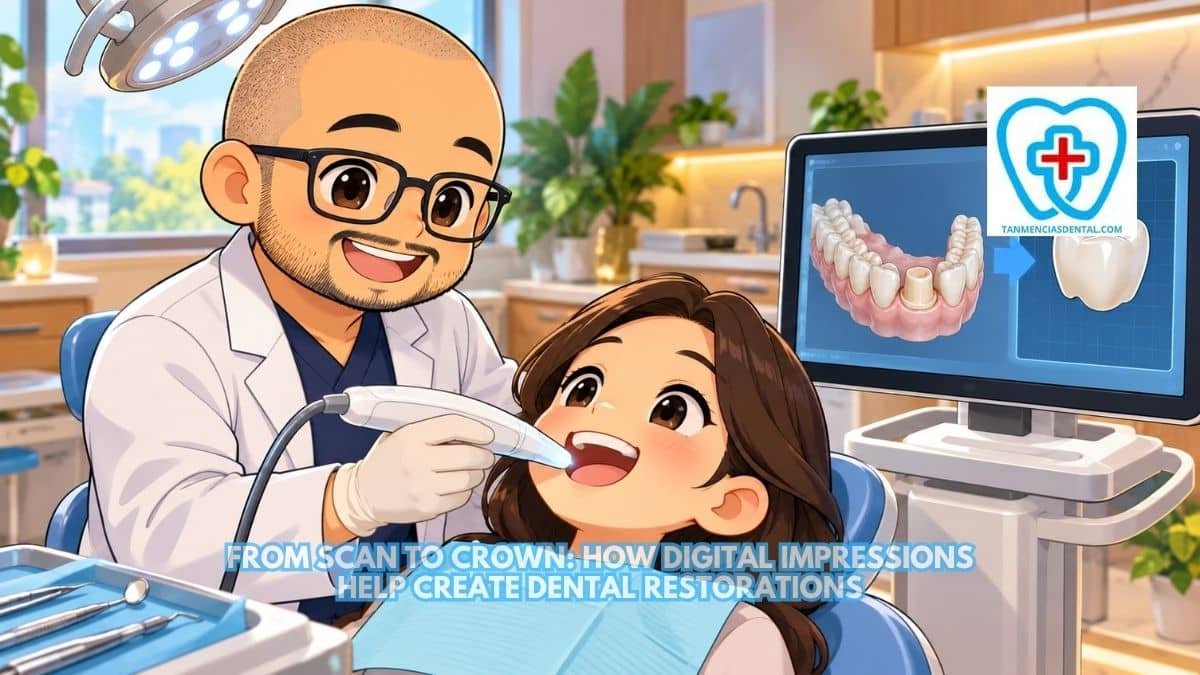
Instead of using impression material to create a physical mold of your teeth, a dentist can use an intraoral scanner to capture detailed information about your teeth and surrounding oral structures. Specialized software processes the scan data to create a three-dimensional digital model.
This digital model can then become part of the workflow for designing and producing crowns and other dental restorations.
But what actually happens between scanning your tooth and receiving the finished crown? Here’s a closer look.
Key Takeaways
- Digital impressions use an intraoral scanner to create a 3D digital representation of your teeth and other relevant oral structures.
- They can be used in the fabrication of crowns, bridges, inlays, onlays, implant-supported restorations, and other dental appliances, depending on the case.
- The digital scan can be transferred to computer-aided design (CAD) software to help design the restoration.
- Depending on the dental clinic’s equipment and workflow, the digital file may be used in-house or sent electronically to a dental laboratory.
- Many patients may find digital scanning more comfortable than conventional impressions, particularly because there is no tray filled with impression material that needs to set in the mouth.
- Digital impressions can provide clinically acceptable accuracy for many restorations, but they are not automatically better than conventional impressions in every situation.
- The quality of the final restoration depends on the entire treatment process, not just the scanner.
What Is a Digital Dental Impression?
A dental impression records the shape and position of your teeth and other relevant oral structures. Dentists use this information when planning and creating restorations that need to fit your mouth accurately.
With a conventional impression, impression material is placed in a tray and positioned over the teeth. Once the material sets, the impression is removed and can be used to produce a physical model.
A digital impression captures this information optically instead.
Your dentist moves a small intraoral scanner around your teeth. The device captures images or scan data from different angles, and specialized software combines this information to create a three-dimensional digital model.
The model can then be viewed, enlarged, rotated, and evaluated on a computer.
🦷 How Digital Oral Scans Help Plan Clear Aligner Treatment
From Digital Scan to Dental Crown: How Does It Work?
The exact workflow varies depending on the dental clinic, scanner, dental laboratory, restorative material, and individual case. However, creating a crown using a digital impression generally involves the following steps.
1. Your Tooth Is Examined and Prepared
Before recommending a crown, your dentist first examines the tooth and determines whether a crown is an appropriate treatment.
If treatment proceeds, damaged or decayed tooth structure may need to be removed. The tooth is then prepared to provide enough space and an appropriate shape for the restoration.
The amount and type of preparation depend on several factors, including the condition of the tooth and the restorative material being used.
2. A Digital Scan Is Taken
Once the tooth has been prepared and the area is ready to record, your dentist uses an intraoral scanner to capture the necessary surfaces.
The dentist usually needs more than a scan of the prepared tooth itself. Information about nearby teeth and how the upper and lower teeth come together can also be important when designing the restoration.
Depending on the case, the digital impression may include:
- The prepared tooth
- Neighboring teeth
- Relevant gum tissues
- Teeth in the opposing arch
- Your bite with your teeth together
The software processes this information to create the digital models needed for the restoration.
3. The Digital Impression Is Checked
One advantage of a digital workflow is that the dentist can review the scan on a screen.
This makes it possible to check whether important areas have been captured clearly before proceeding. If part of the scan is incomplete or unclear, the dentist may be able to rescan that particular area rather than repeat an entire conventional impression.
However, the technology still depends on good clinical technique.
Saliva, blood, moisture, limited access, the position of the restoration margin, patient movement, scanning technique, and the scanner itself can all influence the quality of a digital impression.
4. The Crown Is Designed Digitally
Once the scan is considered satisfactory, the digital information can be transferred into a computer-aided design (CAD) workflow.
Using specialized software, the dentist or dental laboratory can design the crown while considering factors such as:
- The shape of the prepared tooth
- Available space for the restorative material
- Adjacent teeth
- Contact points
- Opposing teeth
- The patient’s bite
- Crown shape and contours
- Functional and aesthetic requirements
Software can assist with this process, but professional judgment remains essential. The restoration still needs to meet the clinical requirements of the individual patient.
5. The Crown Is Manufactured
Once the restoration has been designed, the digital design can be used to manufacture the crown.
One common method is computer-aided manufacturing (CAM), in which the restoration is milled from a block of suitable dental material. Depending on the material and workflow, other digital manufacturing processes may also be used.
Some dental clinics have equipment that allows certain restorations to be designed and manufactured on-site. In other cases, the digital impression is sent electronically to a dental laboratory, where the restoration is designed and/or fabricated before being returned to the clinic.
This distinction is important: having a digital impression does not necessarily mean you will receive a same-day crown.
Whether a restoration can be completed in one visit depends on the clinic’s equipment, the material being used, the complexity of the case, and the treatment plan.
6. The Crown Is Tried In and Evaluated
Digital technology does not eliminate the need for your dentist to carefully evaluate the finished restoration.
Before final placement, the dentist may check factors such as:
- How well the crown fits the prepared tooth
- Contact with neighboring teeth
- Your bite
- Crown shape and contours
- Appearance and shade, when relevant
Adjustments may be made when necessary.
7. The Crown Is Bonded or Cemented
Once the dentist is satisfied with the restoration, the crown can be attached to the prepared tooth using an appropriate dental cement or adhesive system.
The exact procedure depends on factors such as the restorative material, tooth preparation, and clinical situation.
Your dentist will typically perform final checks to make sure the crown and bite are satisfactory.
🦷 Digital Oral Scans vs. Traditional Dental Impressions: What’s the Difference?
What Are the Benefits of Digital Impressions?
For patients, one of the most noticeable differences is simple: there is usually no large tray of impression material that has to remain in the mouth while the material sets.
This may be especially helpful for people who have difficulty tolerating conventional impression trays or who have a sensitive gag reflex.
Digital impressions can also provide practical advantages during treatment.
Immediate Review
Because the digital model can be viewed on a screen, the dentist can assess the scan before proceeding with the restoration.
Selective Rescanning
If a small area was not recorded adequately, that section may be rescanned rather than repeating the entire impression.
Digital Transfer
Digital scan files can be transmitted electronically to a compatible dental laboratory, potentially simplifying communication and eliminating the need to physically transport a conventional impression.
Easier Visualization
Digital models can be enlarged and viewed from different angles, which can help the dental team assess the preparation and communicate about the restoration.
🦷 What Is a Digital Oral Scan? A Patient’s Guide to Your Appointment
Are Digital Impressions More Accurate?
This question needs a little nuance.
Research indicates that digital impressions can achieve clinically acceptable accuracy for many restorative applications, including single-unit crowns.
Studies comparing digital and conventional impressions for single crowns have generally found digital workflows to be comparable to conventional methods, with some research showing advantages in certain measurements of crown fit.
However, this does not mean that a digital impression is always more accurate.
Accuracy can depend on factors such as:
- The scanner being used
- The dentist’s scanning technique
- The length of the area being scanned
- Moisture and soft-tissue management
- The type and location of the restoration
- The number and position of dental implants, when applicable
- Patient movement and access inside the mouth
Full-arch and complex implant cases can present different challenges from scanning a single prepared tooth.
So, digital doesn’t automatically mean perfect, or automatically mean better.
The scanner is one part of a much larger restorative process. Diagnosis, tooth preparation, moisture control, management of the gums, impression quality, design, manufacturing, material selection, and final placement can all affect the outcome.
🦷 Can You Brush Your Teeth After a Filling? What You Need to Know
Digital vs. Traditional Impressions: Which Is Better?
For many patients and restorations, digital impressions can offer a convenient and comfortable alternative to conventional impressions.
But conventional impressions have not become obsolete. They remain a useful and established technique and may be appropriate in situations where a dentist determines that a traditional impression is preferable.
Rather than thinking of one technique as universally better, it is more helpful to view digital and conventional impressions as different methods of accurately recording the mouth.
Your dentist can determine which approach is most suitable for your particular restoration and clinical situation.
🦷 How Often Should You Visit the Dentist? Building a Dental Care Plan for Long-Term Oral Health
What Dental Restorations Can Be Made Using Digital Impressions?
Digital scanning has applications beyond crowns.
Depending on the patient’s needs, the equipment available, and the workflow used by the dentist and dental laboratory, intraoral scans may be incorporated into treatment involving:
- Dental crowns
- Dental bridges
- Inlays and onlays
- Implant-supported restorations
- Orthodontic appliances and clear aligners
- Bite splints and other oral appliances
- Certain surgical guides
Not every case can or should follow an entirely digital workflow, so your dentist will determine whether digital scanning is appropriate for your treatment.
🦷 Mouth Peels After Brushing Teeth: Why It Happens and What You Can Do
What Does a Digital Dental Scan Feel Like?
From the patient’s perspective, the process is generally straightforward.
A small scanning wand is moved around the teeth while the digital model appears on a computer screen. You may be asked to open wider, move your tongue, or bite your teeth together while different areas are recorded.
You may experience some pressure or temporary discomfort from keeping your mouth open, particularly when teeth toward the back of the mouth need to be scanned. However, digital scanning generally avoids having a tray filled with impression material remain in your mouth while it sets.
The time required for the scan varies depending on the area being recorded, the complexity of the case, the equipment, and the operator.
🦷 Beyond the Dental Checkup: Benefits of an Advanced Dental Health Program
🦷 Digital Oral Scan in Marikina
Does a Digital Scan Guarantee a Better Crown?
No.
A high-quality digital impression gives the dentist and dental laboratory accurate information to work with, but the scanner alone does not determine whether a crown will be successful.
A well-made restoration depends on the entire process, including:
- Proper diagnosis and treatment planning
- Appropriate tooth preparation
- Management of the gums and moisture
- An accurate impression or scan
- Restoration design
- Suitable material selection
- Accurate manufacturing
- Proper bonding or cementation
- Bite adjustment
- Oral hygiene and ongoing dental care
Think of the digital scan as the blueprint for the restoration rather than the finished result.
🦷 Can You Die From a Tooth Abscess? Understanding the Risks and Symptoms
🦷 Trusted Dental Experts in Marikina City
The Bottom Line
Digital impressions have changed the way dentists can plan and create dental restorations.
Instead of first making a physical impression of your teeth, an intraoral scanner can capture the necessary information digitally. That data can then become part of a CAD/CAM workflow used to design and manufacture a crown or other restoration.
For many patients, the most noticeable advantage is a more convenient impression experience without a tray of impression material setting in the mouth. Behind the scenes, digital scanning can also streamline communication between the dentist and dental laboratory.
But the technology is only one part of good restorative dentistry.
Whether your dentist uses a digital scan, a conventional impression, or a combination of techniques, the goal remains the same: to create a restoration that fits properly, functions comfortably, protects the tooth, and works well with the rest of your mouth.
Frequently Asked Questions
Are digital dental impressions painful?
The scanning process itself is noninvasive and should generally not be painful. You may experience temporary discomfort from keeping your mouth open or while the scanner reaches teeth farther back in the mouth. Tooth preparation and other dental procedures performed before the scan are separate from the scanning process and may require local anesthesia.
Are digital impressions good for people with a gag reflex?
They may be easier for some people with a sensitive gag reflex because an intraoral scan does not require a conventional tray filled with impression material to remain in the mouth while the material sets. However, individual experiences vary.
How long does a digital dental scan take?
There is no single standard scanning time. It depends on how much of the mouth needs to be recorded, the complexity of the case, the scanner, and the operator.
Can I get a same-day crown with a digital impression?
Possibly, but a digital scan alone does not make a crown a same-day restoration. Same-day treatment requires appropriate design and manufacturing equipment, and not every tooth, crown material, or clinical situation is suitable for a same-day workflow.
If the crown is being fabricated by an external dental laboratory, another appointment may be required.
Are digital impressions as accurate as traditional impressions?
For many restorations, including single crowns, research indicates that digital impressions can provide clinically acceptable results and can be comparable to conventional impressions.
Accuracy depends on the clinical situation, scanner, scanning technique, area being scanned, and other factors. Complex or full-arch cases may have different requirements.
Can digital impressions be used for dental implants?
Yes. Digital impressions can be incorporated into many implant-restoration workflows. However, the suitability and accuracy of a digital workflow depend on factors such as the number and position of implants, the area being scanned, equipment, and scanning technique.
Your dentist or prosthodontist can determine which impression method is appropriate for your implant restoration.
Will I still need a temporary crown?
Possibly.
If your permanent crown cannot be completed during the same appointment, a temporary crown may be placed to protect the prepared tooth until the final restoration is ready.
Whether you need a temporary crown depends on your treatment plan and the restorative workflow being used.
Are digital impressions available at every dental clinic in the Philippines?
No. Intraoral scanners and chairside CAD/CAM equipment require specialized technology and training, and availability varies among dental clinics in the Philippines.
If digital impressions are important to you, ask your dental clinic whether it offers intraoral scanning and whether the technology can be used for the type of restoration you need.
Learn More About Digital Dental Care at Tan-Mencias Dental Clinic
If you have questions about digital impressions, dental crowns, or other dental treatments, visit Tan-Mencias Dental Clinic at 44 G. Del Pilar Street, Parang, Marikina City. Our dental team can check your teeth and help you understand which treatment may be right for you. You can call our clinic at 0917-145-1074 if you have any questions or concerns. You can also send us a message through our Facebook page or our website’s contact form. We look forward to helping you care for your smile and making your dental visit as comfortable as possible.
Medical Disclaimer
This article is provided for general educational and informational purposes only and should not be considered a substitute for professional dental or medical advice, diagnosis, or treatment.
Dental conditions and appropriate treatments vary from person to person. If you have tooth pain, a broken or damaged tooth, problems with an existing crown or restoration, or questions about digital impressions and dental crowns, consult a licensed dentist in the Philippines for an examination and treatment recommendations based on your individual oral health needs.