
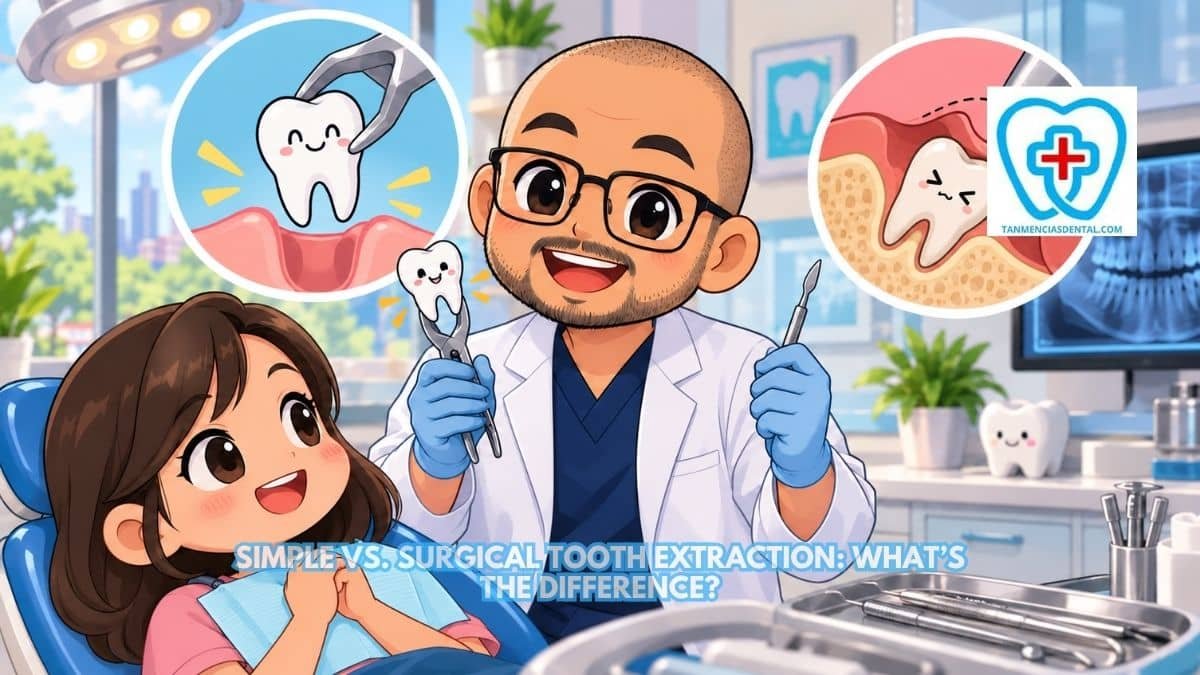
If your dentist tells you that a tooth needs to be removed, you may hear the terms simple extraction and surgical extraction. While both procedures involve removing a tooth, they differ mainly in how accessible the tooth is and how much work is needed to remove it safely.
A simple tooth extraction is generally performed when the tooth is visible above the gumline and can be loosened and removed using dental instruments without making a surgical incision.
A surgical tooth extraction, on the other hand, may be necessary when a tooth is impacted, badly broken, located below the gumline, or otherwise difficult to access. It may involve opening the gum, removing a small amount of bone, or dividing the tooth into smaller sections before removal.
Both are common dental procedures. The type of extraction your dentist recommends will depend on the condition and position of the tooth, its roots, the surrounding bone, and other clinical factors.
Key Takeaways
- Simple extractions are generally used for teeth that have fully erupted and are easily accessible.
- Surgical extractions may require an incision in the gum, removal of some surrounding bone, or sectioning of the tooth.
- Local anesthesia is commonly used to keep the area numb during either procedure.
- Surgical extractions may involve more postoperative swelling and a somewhat longer recovery than uncomplicated simple extractions.
- Impacted wisdom tooth removal is a common example of surgical extraction and may also be referred to as odontectomy in the Philippines.
- Your dentist will determine the most appropriate approach after examining the tooth and, when necessary, reviewing dental X-rays or other imaging.
What Is a Simple Tooth Extraction?
A simple extraction is usually performed when enough of the tooth is visible above the gumline for the dentist to access and remove it without surgically opening the gum.
Before the procedure, the dentist applies local anesthesia to numb the tooth and surrounding tissues. The tooth is then carefully loosened using dental instruments. Once sufficiently mobile, it can be removed from its socket.
You may feel pressure or movement during the procedure, but the anesthetized area should not feel sharp pain. If you do experience pain, tell your dentist immediately so additional anesthesia can be given if appropriate.
When Is a Simple Extraction Used?
A simple extraction may be appropriate for:
- Severely decayed teeth that can no longer be predictably restored
- Teeth damaged by trauma
- Very loose teeth affected by advanced gum disease
- Certain teeth removed as part of orthodontic treatment
- Retained primary or baby teeth
- Other fully erupted teeth that need to be removed
However, a tooth that appears straightforward at first may still be difficult to remove because of its root shape, previous dental treatment, extensive decay, fractures, or the condition of the surrounding bone.
For this reason, your dentist usually evaluates both the visible tooth and its roots before deciding how the extraction should be performed.
🦷 Can You Brush Your Teeth With Hydrogen Peroxide? Benefits, Risks, and What You Should Know
What Is a Surgical Tooth Extraction?
A surgical extraction is used when a tooth cannot be safely or predictably removed using a simple extraction technique.
After the area is numbed with local anesthesia, the dentist may make a small incision in the gum to gain better access to the tooth. In some cases, a small amount of surrounding bone may need to be removed.
The tooth may also be divided into smaller sections so that each part can be removed more easily and with less stress on the surrounding tissues.
Depending on the procedure, stitches or sutures may be placed afterward to help the gum tissue heal.
For impacted teeth, particularly impacted third molars or wisdom teeth, surgical removal may also be called an odontectomy, a term commonly used in dental practice in the Philippines.
🦷 What’s the Difference Between Dental Floss and Dental Tape?
When Is Surgical Extraction Necessary?
A surgical approach may be needed for:
- Impacted wisdom teeth that are partly or completely trapped beneath the gum or bone
- Teeth broken at or below the gumline
- Teeth with roots that are curved, widely separated, or otherwise difficult to remove
- Teeth covered by bone or gum tissue
- Teeth that fracture during an attempted simple extraction
- Severely damaged teeth that cannot be adequately grasped with conventional extraction instruments
The need for surgery is determined on a case-by-case basis.
🦷 Tooth Extraction Aftercare: What to Do and What to Avoid for a Smooth Recovery
Simple vs. Surgical Tooth Extraction: A Quick Comparison
| Simple Extraction | Surgical Extraction | |
| Tooth position | Usually fully erupted and accessible | May be impacted, broken, or difficult to access |
| Gum incision | Usually not needed | May be needed |
| Bone removal | Usually not needed | May be necessary |
| Tooth sectioning | Usually not necessary | May be necessary |
| Local anesthesia | Commonly used | Commonly used |
| Stitches | Usually unnecessary | May be required |
| Complexity | Generally lower | Generally higher |
| Recovery | Often relatively straightforward | May involve more swelling and discomfort |
These are general differences rather than strict rules. Sometimes an extraction that begins as a simple procedure needs to be converted to a surgical extraction if the tooth fractures or proves more difficult to remove than expected.
🦷 How to Clean Teeth After Braces Removal: Tips for Maintaining Your Best Smile
Does a Surgical Tooth Extraction Hurt More?
This is understandably one of the most common concerns patients have.
During either a simple or surgical extraction, local anesthesia is normally used to numb the treatment area. You may feel pressure, pushing, pulling, or vibration during the procedure, but you should not simply endure sharp pain. Tell your dentist if you are uncomfortable.
The main difference between simple and surgical extraction is often more noticeable after the procedure.
Because a surgical extraction may involve the gum tissue and surrounding bone, you may experience more:
- Swelling
- Soreness
- Mild bruising
- Jaw stiffness
These symptoms are often most noticeable during the first few days before gradually improving.
Your dentist will provide instructions for managing pain and swelling based on your procedure, health history, and individual needs.
🦷 Can a Dental Hygienist Work as a Dental Assistant in the Philippines?
Is Sedation Needed for a Surgical Extraction?
Not necessarily.
Many simple and surgical extractions can be performed under local anesthesia alone. Depending on the complexity of the procedure, your individual needs and anxiety level, available facilities, and the dentist’s treatment plan, additional anxiety-management or sedation options may sometimes be considered.
Your dentist can explain which options, if any, are appropriate and available for your particular case.
🦷 Signs You May Need a Tooth Extraction
How Long Does Recovery Take?
There is no single recovery timeline that applies to everyone.
After an uncomplicated simple extraction, many patients can return to routine, non-strenuous activities relatively soon. Surgical extractions, especially impacted wisdom tooth removal, may cause more noticeable discomfort and swelling during the first several days.
It is also important to understand the difference between feeling better and being completely healed.
Your discomfort may improve within days, while the gum tissue and underlying extraction socket continue healing for weeks. Bone remodeling can continue for considerably longer.
Your dentist can give you a more specific estimate based on the tooth being removed and the complexity of your procedure.
🦷 What Is a Dentist Uniform Called? A Guide to Dental Scrubs and PPE
What Should You Expect After a Tooth Extraction?
After your tooth is removed, a blood clot normally forms inside the extraction socket. This clot plays an important role in healing because it protects the underlying tissues while the area begins to repair itself.
Your dentist may ask you to bite gently but firmly on gauze for a certain period after the procedure to help control bleeding.
You will also receive postoperative instructions. These commonly include recommendations such as:
- Avoid vigorous rinsing or forceful spitting during the early healing period.
- Avoid disturbing the extraction site with your fingers or tongue.
- Avoid smoking and vaping while the area is healing.
- Avoid drinking through a straw during the early healing period if advised by your dentist.
- Avoid strenuous exercise or physical activity immediately after the procedure.
- Start with soft foods and gradually return to your usual diet as tolerated.
- Continue oral hygiene carefully while following instructions for cleaning around the extraction site.
Your dentist’s specific instructions should always take priority, since recommendations can vary depending on the procedure and your individual circumstances.
🦷 Tooth Extraction: What to Expect Before, During, and After the Procedure
What Is Dry Socket?
Dry socket, medically known as alveolar osteitis, is a painful complication that can develop after a tooth extraction.
It occurs when the protective blood clot within the socket is lost or breaks down before the area has adequately healed.
Instead of gradually getting better, a person with dry socket may develop significant or worsening pain several days after an extraction. The pain may spread toward the ear, temple, or jaw. An unpleasant taste or odor may also occur.
Smoking and tobacco use can increase the risk of dry socket and other healing problems.
If your pain becomes significantly worse instead of gradually improving, contact your dentist. Dry socket can be treated professionally and should not be managed by placing medications, chemicals, or home remedies directly into the extraction socket unless instructed by a dental professional.
🦷 Basic Dental Needs in Marikina
What Are the Possible Risks of Tooth Extraction?
Tooth extraction is commonly performed, but no dental procedure is completely free of risk.
Possible complications can include:
- Bleeding
- Infection
- Swelling and bruising
- Dry socket
- Delayed healing
- Damage to a neighboring tooth or dental restoration
- Temporary or, less commonly, persistent changes in sensation from nerve involvement
- Sinus-related complications following extraction of certain upper teeth
The likelihood of these problems varies depending on the tooth, the procedure, your health, and other individual factors.
Before treatment, tell your dentist about any medical conditions, allergies, prescription medicines, over-the-counter medicines, and supplements you take.
This is particularly important if you take medicines that affect bleeding or blood clotting or if you have a medical condition that could influence dental treatment or healing.
Do not stop a prescribed medication on your own before a dental procedure. Your dentist can determine whether consultation with your physician is necessary.
🦷 Marikina’s Trusted Dental Professionals
Do You Need Medical Clearance Before a Tooth Extraction?
Not everyone needs medical clearance before having a tooth removed.
However, your dentist may recommend consultation with your physician if you have certain medical conditions, take certain medications, or if additional information is needed to determine how dental treatment should be carried out safely.
The decision should be based on your individual health history rather than assuming that every patient with a medical condition automatically needs medical clearance.
Who Can Perform Tooth Extractions in the Philippines?
In the Philippines, tooth extraction falls within the professional practice of a duly licensed dentist.
Many routine and straightforward extractions are performed in general dental clinics. Dentists with appropriate training and experience may also perform surgical extractions.
For more complex cases, such as deeply impacted teeth, difficult anatomy, teeth close to important nerves or other structures, or patients with significant medical considerations, the dentist may recommend referral to a practitioner with advanced training or experience in oral surgery, such as an oral and maxillofacial surgeon when appropriate.
A referral does not necessarily mean something is seriously wrong. It may simply be the safest and most appropriate way to manage a more complex case.
How Does Your Dentist Decide Which Extraction You Need?
Your dentist may consider several factors, including:
- Whether the tooth has fully erupted
- How much tooth structure remains above the gumline
- The number, shape, and position of its roots
- Whether the tooth is impacted
- The amount and condition of the surrounding bone
- The tooth’s relationship to nearby teeth, nerves, and sinuses
- The presence of infection or inflammation
- Previous dental treatment
- Your general health and medical history
Dental X-rays are commonly used because they allow your dentist to see the roots and surrounding structures that cannot be evaluated simply by looking inside the mouth.
For selected complex cases, more detailed three-dimensional imaging, such as cone-beam computed tomography (CBCT), may be recommended.
Ultimately, the terms simple and surgical describe the approach needed to remove the tooth. They do not necessarily indicate how serious your dental condition is.
The Bottom Line
The main difference between a simple and surgical tooth extraction comes down to accessibility and complexity.
If a tooth has fully erupted and can be safely loosened and removed through its socket, a simple extraction may be appropriate.
If the tooth is impacted, badly broken, covered by gum or bone, or otherwise difficult to remove, a surgical extraction may be necessary. This can involve making an incision, removing a small amount of bone, sectioning the tooth, or a combination of these techniques.
The best way to know which procedure you need is through a proper dental examination and appropriate imaging when indicated.
If your dentist recommends an extraction, don’t hesitate to ask why the tooth needs to be removed, what type of extraction is expected, what anesthesia will be used, what recovery may involve, and which warning signs you should watch for afterward.
Frequently Asked Questions
1. Is a surgical tooth extraction considered surgery?
Yes. A surgical extraction is a minor oral surgical procedure that may involve opening the gum, removing some surrounding bone, sectioning the tooth, or using other surgical techniques to remove it safely.
2. Is odontectomy the same as surgical tooth extraction?
Odontectomy refers to the surgical removal of a tooth, particularly an impacted tooth such as an impacted wisdom tooth. You may commonly encounter this term in dental clinics and hospitals in the Philippines.
3. Are wisdom teeth always surgically removed?
No. A wisdom tooth that has fully erupted and is easily accessible may sometimes be removed using a relatively straightforward extraction technique. Impacted or partially erupted wisdom teeth are more likely to require surgical removal.
4. Can a simple extraction turn into a surgical extraction?
Yes. Occasionally, a tooth or root may fracture during removal, or the dentist may determine that it cannot be safely removed with a simple technique. A surgical approach may then be necessary.
5. Do I need stitches after a tooth extraction?
Not always. Simple extractions frequently do not require stitches. Surgical extractions may require sutures depending on the incision, extraction site, and procedure performed.
Your dentist will also tell you whether the stitches are absorbable or need to be removed at a follow-up visit.
6. How long will bleeding continue after an extraction?
Mild oozing or blood-tinged saliva can occur during the early hours after an extraction. Follow your dentist’s instructions regarding gauze, pressure, food, and activity.
Contact your dentist if bleeding is heavy, does not improve despite following the instructions you were given, or concerns you.
7. Can I go back to work after a tooth extraction?
It depends on the complexity of the extraction, the type of work you do, and how you feel afterward.
Some patients can return to light activities relatively quickly after a simple extraction. After a surgical extraction, you may need additional time to recover, particularly if your job involves strenuous physical activity.
Ask your dentist for advice based on your specific procedure.
8. When can I eat after a tooth extraction?
Follow your dentist’s instructions, particularly while your mouth is still numb. Soft foods are generally easier to manage during the early recovery period.
Be careful not to accidentally bite your cheek, lip, or tongue while the anesthesia is still working.
9. Do I need antibiotics after a tooth extraction?
Not necessarily. Antibiotics are not automatically required after every tooth extraction.
Your dentist will decide whether antibiotics are appropriate based on factors such as the presence and nature of an infection, your medical history, the procedure performed, and your individual risk factors.
Do not take leftover antibiotics or use antibiotics for a dental problem without appropriate professional advice.
10. When should I contact my dentist after an extraction?
Contact your dental clinic if you experience symptoms such as:
- Severe or worsening pain
- Heavy or persistent bleeding
- Swelling that becomes significantly worse rather than gradually improving
- Fever or other signs that may suggest infection
- Pus or concerning discharge
- Persistent or unexpected numbness
- Any postoperative symptom that concerns you
Seek urgent medical attention for potentially serious symptoms such as difficulty breathing or swallowing, rapidly increasing facial or neck swelling, or uncontrolled bleeding.
Self-Promotion
If you think you may need a tooth removed, the team at Tan-Mencias Dental Clinic is here to help. Visit us at 44 G. Del Pilar Street, Parang, Marikina City, so we can check your tooth and explain whether a simple or surgical extraction may be needed. If you have questions or concerns, you can call our dental clinic or reach us at 0917-145-1074. You can also send us a message through our Facebook page or our website’s contact form. We’ll be happy to guide you and help you understand your treatment options.
Medical Disclaimer
This article is intended for general educational and informational purposes only and should not be considered a substitute for professional dental or medical advice, diagnosis, or treatment.
Dental conditions, extraction procedures, medications, and recovery recommendations vary from person to person. Always consult a duly licensed dentist in the Philippines or another appropriately qualified healthcare professional for advice regarding your individual circumstances.
If you have severe or uncontrolled bleeding, difficulty breathing or swallowing, rapidly worsening facial or neck swelling, or another potentially serious medical problem following dental treatment, seek urgent medical attention.