
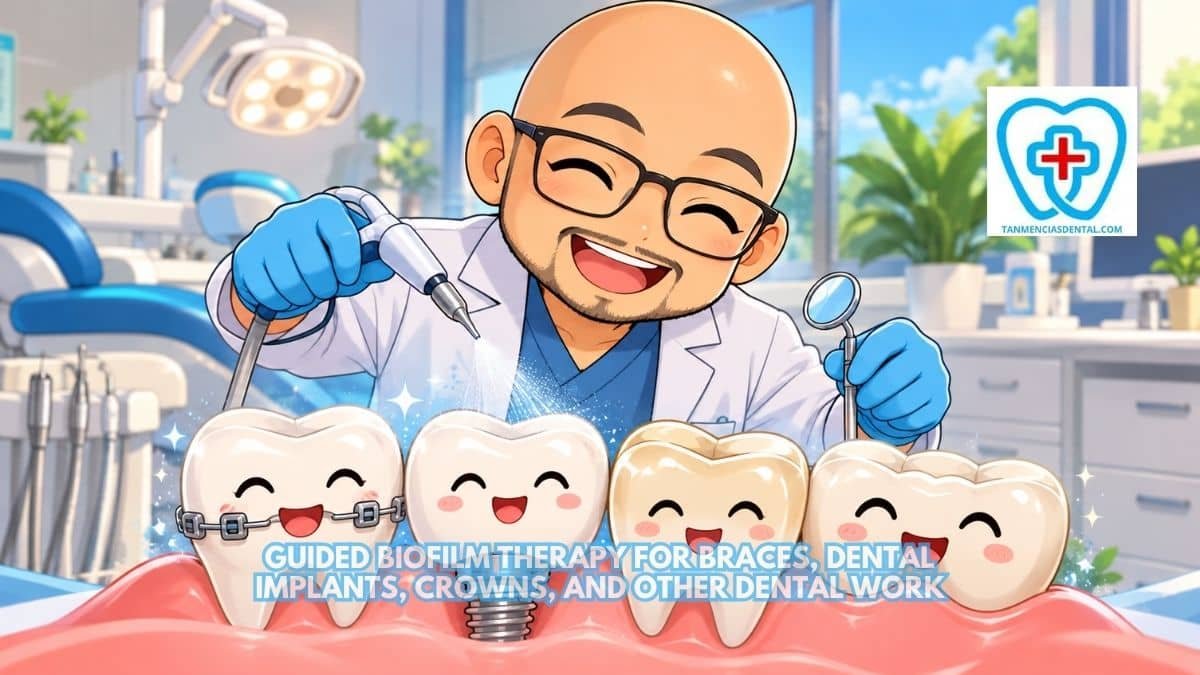
Keeping your teeth and gums healthy can be challenging, especially when you have braces, dental implants, crowns, bridges, or other dental restorations.
These treatments can improve your smile, restore damaged teeth, and help you chew more comfortably. However, they can also create additional spaces where dental plaque accumulates.
For example, food particles and bacteria can collect around orthodontic brackets, along the edges of dental crowns, and beneath certain dental bridges. Even with regular brushing and flossing, some areas can be difficult to clean thoroughly.
This is where Guided Biofilm Therapy (GBT) may help.
Guided Biofilm Therapy is a systematic approach to professional dental cleaning that focuses on identifying and removing dental biofilm, the sticky layer of microorganisms commonly known as dental plaque.
It combines plaque-disclosing agents, specialized air-polishing technology, targeted scaling, and personalized oral hygiene instructions.
But how does GBT work for people with braces, implants, crowns, and other dental work? Is it safe, and how does it compare with conventional dental cleaning?
Let’s explore what you need to know.
Key Takeaways
- Guided Biofilm Therapy (GBT) is a structured professional dental cleaning protocol that helps identify and remove dental biofilm from teeth and suitable dental restorations.
- GBT can be useful for patients with braces because it helps dental professionals identify and clean plaque around brackets, wires, and other difficult-to-reach areas.
- Dental implants require regular maintenance. GBT may help control biofilm around implant-supported restorations, but it does not replace treatment for peri-implant diseases.
- Crowns, bridges, veneers, and fillings can generally be cleaned using appropriately selected GBT techniques, although some materials require special precautions.
- GBT may provide a more comfortable cleaning experience for some patients, particularly when low-abrasive powders are used.
- GBT does not replace conventional scaling when tartar is present. Removing hardened deposits remains an important part of professional dental cleaning.
- Not everyone needs GBT. Your dentist should recommend the most appropriate cleaning method based on your oral health, dental work, and individual needs.
What Is Guided Biofilm Therapy?
Guided Biofilm Therapy is a professional dental cleaning protocol developed by EMS (Electro Medical Systems), a Swiss dental equipment manufacturer.
Unlike conventional cleaning approaches that may begin with scaling, GBT emphasizes identifying and removing soft bacterial biofilm before targeting any remaining hardened deposits.
The treatment uses specialized equipment and techniques to clean teeth and suitable dental restorations while minimizing unnecessary abrasion.
What Is Dental Biofilm?
Dental biofilm is a structured community of microorganisms that forms naturally on teeth and other surfaces inside the mouth.
You probably know it as dental plaque.
Although biofilm formation is normal, allowing plaque to accumulate can contribute to several oral health problems, including:
- Tooth decay or cavities
- Gingivitis (gum inflammation)
- Periodontitis (advanced gum disease)
- Persistent bad breath
- Inflammation around dental implants
- White spot lesions around orthodontic brackets
When plaque remains on your teeth, minerals in saliva can cause it to harden into calculus, commonly called tartar.
Unlike soft plaque, hardened tartar cannot be removed through ordinary brushing and flossing.
This is why professional dental cleaning remains important, even if you maintain good oral hygiene at home.
Why Is GBT Different?
One of the distinguishing features of GBT is the use of a plaque-disclosing agent.
This special solution stains dental biofilm, making it easier for your dentist to identify areas that need cleaning.
Instead of relying only on what is visible under normal lighting, the dentist can use the disclosed plaque as a guide.
This also helps you understand which areas you may be missing when brushing and flossing.
🦷 Can Salt Whiten Teeth? Benefits, Risks, and What Dentists Say
How Does Guided Biofilm Therapy Work?
GBT follows an eight-step protocol designed to make professional dental cleaning systematic and patient-focused.
Step 1: Assessment
Your dentist examines your teeth, gums, and existing dental work.
This may include checking for cavities, gum inflammation, tartar, periodontal pockets, and problems with dental restorations.
Your medical and dental history will also be reviewed to determine whether GBT is appropriate.
Step 2: Biofilm Disclosure
A plaque-disclosing agent is applied to your teeth.
The solution temporarily stains areas where dental biofilm has accumulated, allowing your dentist to identify plaque that might otherwise be difficult to see.
Step 3: Patient Education
Your dentist shows you where plaque tends to accumulate and explains how to improve your daily oral hygiene.
If you have braces, implants, or dental bridges, you may receive instructions on using interdental brushes, floss threaders, or other cleaning tools.
Step 4: AIRFLOW Cleaning
A specialized AIRFLOW device uses a controlled combination of air, water, and fine cleaning powder to remove biofilm and certain surface stains.
Low-abrasive powders, such as erythritol, are commonly used in the GBT protocol.
This step helps clean accessible tooth surfaces and suitable dental restorations.
Step 5: PERIOFLOW Cleaning
When clinically indicated, a specialized PERIOFLOW nozzle may be used to remove biofilm from certain deeper periodontal pockets or suitable areas around dental implants.
The technique must be selected carefully, particularly around implants or inflamed tissues.
Not every patient requires this step.
Step 6: Targeted Calculus Removal
After soft biofilm has been removed, the dentist identifies any remaining hardened deposits.
These are removed using suitable ultrasonic or manual scaling instruments.
GBT includes scaling when necessary. Air-polishing alone is not a substitute for removing established tartar.
Step 7: Final Examination
Your dentist checks the cleaned areas to ensure that biofilm and calculus have been adequately removed.
The condition of your gums, teeth, and dental restorations may also be reassessed.
Step 8: Recall and Maintenance
Finally, your dentist recommends an appropriate schedule for future dental examinations and professional cleaning.
The frequency depends on your oral health, existing dental work, and risk of developing dental problems.
🦷 Can Guided Biofilm Therapy Help Prevent Gum Disease?
Guided Biofilm Therapy for Braces
If you wear traditional metal or ceramic braces, you probably know that brushing your teeth requires extra effort.
Orthodontic brackets, wires, and other attachments create small spaces where food particles and plaque can accumulate.
Even when you brush regularly, it can be difficult to clean around every bracket.
Over time, inadequate plaque removal can increase your risk of gum inflammation, cavities, and white spot lesions.
White spot lesions are areas of enamel demineralization that may become noticeable during orthodontic treatment or after braces are removed.
How Can GBT Help Patients With Braces?
GBT may be useful during orthodontic treatment because it allows your dentist to:
- Identify plaque around brackets and orthodontic wires.
- Remove biofilm from accessible surfaces around fixed appliances.
- Clean certain difficult-to-reach areas using suitable air-polishing techniques.
- Identify areas where brushing needs improvement.
- Provide personalized oral hygiene instructions.
Plaque disclosure can be particularly helpful because you can see which areas you have been missing.
Is GBT Safe for Braces?
Generally, yes.
GBT can be performed on patients wearing fixed orthodontic appliances when appropriate equipment and techniques are used.
However, the dentist must take precautions around loose brackets, damaged attachments, and sensitive areas.
GBT also does not replace your regular orthodontic appointments.
If you have braces, consider asking your dentist whether GBT would be appropriate during your routine professional cleaning.
🦷 Does Guided Biofilm Therapy Hurt? What to Expect During Your GBT Appointment
Guided Biofilm Therapy for Dental Implants
Dental implants are designed to replace missing teeth and restore oral function.
Although dental implants cannot develop cavities like natural teeth, they are still vulnerable to problems involving the surrounding gums and supporting bone.
Two important conditions to understand are peri-implant mucositis and peri-implantitis.
Peri-implant mucositis is inflammation of the soft tissues surrounding a dental implant without progressive loss of supporting bone.
Peri-implantitis involves inflammation around an implant together with progressive loss of supporting bone.
Dental biofilm plays an important role in these conditions, making regular plaque control essential.
How Can GBT Help Maintain Dental Implants?
GBT may help maintain dental implants by:
- Removing biofilm from accessible implant-supported restorations.
- Cleaning suitable surfaces around implant components.
- Helping control plaque accumulation around the surrounding gums.
- Identifying areas that require better daily cleaning.
- Supporting a regular professional maintenance program.
Research on low-abrasive air-polishing suggests that it can be useful for removing biofilm from suitable implant surfaces. However, available evidence does not establish that it is superior to all other cleaning methods for every patient.
Is GBT Safe for Dental Implants?
GBT can be suitable for implant maintenance when performed using appropriate instruments and techniques.
However, dental implants have different surface characteristics, and not every cleaning instrument is appropriate for every implant component.
Your dentist must consider the implant design, condition of the surrounding tissues, and type of restoration.
It is also important to distinguish routine implant maintenance from treatment of an existing implant infection.
GBT should not be considered a stand-alone treatment for peri-implantitis.
Patients with peri-implantitis may require additional non-surgical or surgical periodontal treatment.
If you notice bleeding, swelling, discharge, or discomfort around your dental implant, consult your dentist promptly.
🦷 How to Treat Gingivitis in Kids: A Parent’s Guide to Healthy Gums
Guided Biofilm Therapy for Dental Crowns
Dental crowns are commonly used to restore teeth that have been weakened by decay, fractures, or extensive dental treatment.
Although crowns are designed to protect and restore damaged teeth, they still require proper maintenance.
A common misconception is that crowned teeth can no longer develop cavities.
While the crown itself cannot develop tooth decay, the natural tooth underneath can still be affected, particularly near the crown’s margins.
How Can GBT Help Maintain Dental Crowns?
GBT may help by:
- Removing biofilm around crown margins.
- Cleaning accessible crown surfaces.
- Managing plaque accumulation near the gumline.
- Removing certain external stains from suitable materials.
- Helping identify areas that require better daily cleaning.
Maintaining good oral hygiene around crowns is important because plaque accumulation can contribute to gum inflammation and decay along exposed tooth surfaces.
Can GBT Damage Dental Crowns?
GBT can be used around many dental crowns when appropriate powders and instruments are selected.
However, not all restorative materials respond to cleaning in the same way.
For example, zirconia, porcelain, metal, and resin-based restorations have different surface properties.
Research indicates that air-polishing and ultrasonic instrumentation can affect restorative surfaces, with the degree of change depending on the material and cleaning technique. Low-abrasive powders generally produce less surface alteration than more abrasive alternatives.
This is why your dentist should assess your restorations before selecting a cleaning method.
GBT also cannot repair a loose crown, correct a poorly fitting restoration, or treat decay underneath a crown.
🦷 Guided Biofilm Therapy vs. Traditional Dental Cleaning: What’s the Difference?
Guided Biofilm Therapy for Dental Bridges
Dental bridges replace one or more missing teeth by using neighboring teeth or implants for support.
Although bridges can restore your ability to chew and improve your smile, cleaning beneath and around them can be challenging.
Plaque may accumulate around the supporting teeth and underneath the artificial replacement teeth, known as pontics.
How Can GBT Help?
GBT can help remove biofilm from accessible surfaces around dental bridges and supporting teeth.
Plaque disclosure may also reveal areas where bacteria frequently accumulate.
However, professional cleaning does not replace the need for daily cleaning beneath the bridge.
Depending on the bridge design, your dentist may recommend floss threaders, interdental brushes, or other specialized cleaning tools.
Guided Biofilm Therapy for Veneers, Fillings, and Other Dental Restorations
GBT may also be appropriate for patients with porcelain veneers, composite fillings, fixed retainers, and certain implant-supported prostheses.
However, each type of dental work requires specific considerations.
| Type of Dental Work | How GBT May Help | Important Considerations |
| Porcelain veneers | Removes biofilm around veneer margins | Cleaning must protect polished surfaces and bonding margins |
| Composite fillings | Removes plaque from suitable restoration surfaces | Composite materials may be more susceptible to surface roughening |
| Fixed orthodontic retainers | Helps remove plaque around bonded wires | Loose or damaged retainers require examination |
| Implant-supported bridges | Helps manage biofilm around accessible components | Cleaning techniques depend on implant and prosthetic design |
| Implant-supported dentures | Supports maintenance of accessible implant restorations | Fixed and removable designs require different cleaning methods |
| Removable dentures | May complement professional denture maintenance | Conventional denture-cleaning methods may be more appropriate for the appliance itself |
GBT should be adapted to your dental work rather than applying the same cleaning technique to every surface.
🦷 Can You Die From Cavities? Understanding the Risks of Untreated Tooth Decay
Guided Biofilm Therapy vs. Traditional Dental Cleaning
You may be wondering whether GBT is better than the conventional dental cleaning offered by many dental clinics in the Philippines.
Both approaches aim to remove plaque and calculus, support gum health, and help prevent oral health problems.
The main difference is how the cleaning process is organized.
| Feature | Guided Biofilm Therapy | Conventional Dental Cleaning |
| Plaque identification | Uses disclosing agents as a routine step | Disclosing agents may or may not be used |
| Biofilm removal | Emphasizes low-abrasive air-polishing | Uses scaling, polishing, and other appropriate techniques |
| Tartar removal | Targeted scaling after biofilm removal | Scaling is typically a primary component |
| Patient education | Integrated into the protocol | Depends on the dental clinic and individual appointment |
| Comfort | May be more comfortable for some patients | Depends on the technique and patient sensitivity |
| Dental restorations | Requires material-appropriate cleaning techniques | Also requires material-appropriate techniques |
Is GBT Better Than Conventional Cleaning?
Not necessarily.
GBT offers a structured approach that emphasizes biofilm detection, targeted cleaning, and patient education.
Some patients may also find low-abrasive air-polishing more comfortable than conventional cleaning techniques.
However, traditional professional cleaning remains effective when performed correctly.
Current research does not establish that GBT produces superior long-term oral health outcomes for every patient.
The best cleaning method depends on your oral health, the amount of plaque and tartar present, and whether you have dental restorations or periodontal problems.
🦷 What Is Guided Biofilm Therapy? A Patient’s Guide to Modern Teeth Cleaning
Benefits of Guided Biofilm Therapy
When performed appropriately, GBT offers several potential benefits.
1. Targeted Plaque Removal
Plaque-disclosing agents make biofilm visible, allowing your dentist to identify areas that need attention.
2. Cleaning Around Complex Dental Work
GBT can help remove biofilm from suitable surfaces around braces, implants, crowns, and bridges.
3. Potentially More Comfortable Cleaning
Low-abrasive air-polishing may provide a comfortable cleaning experience for some patients.
However, comfort varies depending on tooth sensitivity, gum condition, and the techniques used.
4. Reduced Unnecessary Scaling
Because soft biofilm is removed first, your dentist can identify where hardened deposits remain and focus scaling on those areas.
5. Improved Oral Hygiene Awareness
Seeing disclosed plaque can help you understand where you need to improve your brushing and interdental cleaning.
6. Support for Long-Term Dental Maintenance
Regular professional biofilm removal, together with good home care, can help manage plaque-related inflammation and support the maintenance of natural teeth and dental restorations.
🦷 Seeing Your Smile in 3D: How Digital Oral Scans Help You Understand Your Treatment
Are There Any Risks or Side Effects?
GBT is generally well tolerated when performed by a properly trained dental professional, but it is not completely risk-free.
Possible side effects and considerations include:
- Temporary tooth sensitivity: Some patients may experience sensitivity during or after cleaning.
- Gum discomfort: Inflamed gums may feel tender or bleed during professional cleaning.
- Soft-tissue irritation: Improper use of air-polishing equipment can irritate or injure oral tissues.
- Restoration surface changes: Unsuitable powders or instruments may affect certain dental materials.
- Medical considerations: Patients with certain respiratory conditions, swallowing difficulties, or other medical concerns may require modified treatment.
Rare complications, including air entering soft tissues, have also been reported with dental air-powered instruments, particularly when used improperly.
Before treatment, inform your dentist about your medical conditions, medications, recent dental surgery, and any problems with your existing restorations.
Your dentist can then determine whether GBT is appropriate or whether another cleaning method would be safer.
🦷 Guided Biofilm Therapy in Marikina
Who Can Benefit From Guided Biofilm Therapy?
GBT may be considered for patients who:
- Wear fixed orthodontic braces.
- Have dental implants or implant-supported restorations.
- Have crowns, bridges, veneers, or fixed retainers.
- Experience frequent plaque accumulation.
- Have difficulty cleaning certain areas of their mouth.
- Require ongoing periodontal maintenance.
- Would benefit from additional oral hygiene guidance.
However, having dental work does not automatically mean you need GBT.
Your dentist should recommend professional cleaning methods based on your clinical needs.
🦷 Complete Holistic Dentistry Services in Marikina
How Often Should You Get Guided Biofilm Therapy?
The ideal frequency depends on your oral health.
Some patients may be advised to undergo professional cleaning approximately every six months.
Others, particularly those with a history of periodontal disease, peri-implant problems, or persistent plaque accumulation, may require maintenance appointments every three to four months.
These intervals are examples rather than fixed recommendations.
Your dentist may suggest a different schedule based on your gum health, oral hygiene, medical history, and dental restorations.
The important thing is to follow an individualized preventive care plan rather than assuming everyone needs cleaning at the same frequency.
How to Care for Your Braces, Implants, Crowns, and Other Dental Work at Home
Professional dental cleaning is important, but maintaining good oral hygiene between appointments is equally essential.
Here are some practical habits worth following.
Brush Your Teeth Twice a Day
Use a soft-bristled toothbrush and fluoride toothpaste.
Pay particular attention to the gumline, crown margins, and areas around orthodontic brackets.
Clean Between Your Teeth Daily
Floss, interdental brushes, and other cleaning aids can help remove plaque from areas your toothbrush cannot reach.
If you have a dental bridge or fixed retainer, your dentist may recommend specialized cleaning tools.
Consider a Water Flosser
A water flosser can be a helpful addition for people with braces, bridges, and certain implant restorations.
However, it should be used as part of a complete oral hygiene routine rather than automatically replacing other interdental cleaning methods.
Limit Frequent Sugary Snacks and Drinks
Frequent sugar exposure increases the risk of tooth decay, especially when plaque accumulates around braces or dental restorations.
You don’t necessarily have to avoid all sweet foods, but reducing how often your teeth are exposed to sugar can help protect your oral health.
Watch for Signs of Dental Problems
Bleeding gums, swelling, persistent bad breath, loose restorations, or discomfort around implants should not be ignored.
Arrange a dental examination if you notice these symptoms.
Attend Regular Dental Checkups
Professional examinations allow your dentist to detect problems that may not be visible or painful in their early stages.
GBT is most effective as part of a comprehensive oral healthcare routine, not as a replacement for daily brushing, interdental cleaning, or regular dental examinations.
Frequently Asked Questions (FAQ)
1. Is Guided Biofilm Therapy available in the Philippines?
GBT may be available at dental clinics in the Philippines that have the appropriate equipment and trained dental professionals.
However, not all clinics offer the complete GBT protocol. Ask your dental clinic about its available cleaning procedures and equipment.
2. Is GBT the same as oral prophylaxis?
Not exactly.
In the Philippines, the term oral prophylaxis is commonly used to describe routine professional dental cleaning.
GBT is a specific protocol that includes plaque disclosure, air-polishing, targeted calculus removal, and patient education.
Both approaches aim to maintain oral health, but their techniques and treatment sequences may differ.
3. Is GBT safe for patients with braces?
Yes, GBT is generally suitable for patients wearing fixed orthodontic braces when appropriate techniques are used.
It may help remove plaque around brackets and wires, although daily cleaning remains essential.
4. Can GBT be performed on dental implants?
Yes. Certain GBT techniques may be used for routine implant maintenance.
However, cleaning methods must be selected carefully to protect implant components and surrounding tissues.
GBT is not a substitute for treating peri-implantitis.
5. Can GBT damage dental crowns or veneers?
Some restorative materials can be affected by unsuitable powders or instruments.
When the dentist selects appropriate techniques based on the material and condition of the restoration, GBT can be used around many crowns and veneers.
6. Is Guided Biofilm Therapy painful?
Many patients tolerate GBT comfortably, and some prefer the sensation of low-abrasive air-polishing.
However, patients with sensitive teeth, exposed roots, or inflamed gums may experience discomfort.
7. Does GBT remove tartar?
Yes. The complete GBT protocol includes targeted removal of remaining tartar using suitable scaling instruments.
Air-polishing is primarily intended for biofilm and stain removal and does not replace necessary calculus removal.
8. Can GBT whiten my teeth?
GBT may remove external stains caused by coffee, tea, tobacco, and certain foods.
This can make your teeth appear cleaner or brighter, but it does not change their natural internal color like professional teeth whitening treatments.
9. How long does a GBT session take?
A routine appointment may take approximately 30–60 minutes, depending on the condition of your teeth and gums.
Patients with extensive dental work, heavy tartar buildup, or periodontal problems may require longer appointments or additional treatment.
10. How much does Guided Biofilm Therapy cost in the Philippines?
The cost varies depending on the dental clinic, location, complexity of the procedure, and whether additional treatments are necessary.
GBT may be priced differently from conventional oral prophylaxis because it involves specialized equipment and materials.
For accurate pricing, ask your chosen dental clinic for a treatment assessment and quotation.
11. How often should I get GBT if I have dental implants?
Your dentist will recommend a maintenance schedule based on the health of your implants and surrounding tissues.
Some patients may require visits every three to four months, while others may be able to follow longer intervals.
12. Can children and teenagers receive GBT?
GBT may be suitable for children and teenagers, including those wearing orthodontic braces.
The dentist should consider the patient’s age, oral health, cooperation, and individual treatment needs.
13. Can I receive GBT immediately after implant surgery?
Not necessarily.
Recently placed implants and healing surgical tissues require special precautions.
Your implant dentist should determine when professional cleaning around the surgical area is appropriate.
14. Is Guided Biofilm Therapy worth it?
GBT may be a useful option if you have complex dental work, persistent plaque accumulation, or difficulty maintaining oral hygiene.
However, it is not essential for every patient, and conventional professional cleaning remains an effective option.
The best approach is to discuss your needs with your dentist and choose a cleaning method that is appropriate for your oral health.
Final Thoughts
Braces, dental implants, crowns, bridges, and other dental restorations can improve your smile and restore important oral functions.
However, maintaining these treatments requires consistent oral hygiene and regular professional care.
Guided Biofilm Therapy offers a systematic approach to dental cleaning by combining plaque disclosure, specialized air-polishing, targeted scaling, and personalized oral hygiene education.
For patients with complex dental work, these features may be particularly useful in managing plaque accumulation around difficult-to-clean areas.
Still, GBT is not necessarily better than conventional cleaning for everyone. Its effectiveness and suitability depend on your individual oral health, the condition of your dental restorations, and the techniques used.
If you have braces, dental implants, crowns, or other dental work, consult your dentist to find out whether Guided Biofilm Therapy is appropriate for you.
With consistent home care and professional dental maintenance, you can help protect your natural teeth, maintain healthier gums, and support the long-term function of your dental restorations.
Medical Disclaimer
This article is provided for general educational and informational purposes only and should not be considered a substitute for professional dental or medical advice, diagnosis, or treatment.
Guided Biofilm Therapy may not be suitable for every patient. Its safety and effectiveness depend on individual oral health conditions, medical history, existing dental restorations, and the techniques used.
Always consult a licensed dentist in the Philippines before undergoing Guided Biofilm Therapy or making significant changes to your oral healthcare routine.
If you experience persistent gum bleeding, swelling, pain, discharge, loose dental restorations, or problems with dental implants, seek professional dental evaluation promptly.
Visit Tan-Mencias Dental Clinic for Your Dental Care Needs
Keeping your teeth and gums healthy is important, especially if you have braces, dental implants, crowns, or other dental work. At Tan-Mencias Dental Clinic, we’re here to help you care for your smile and keep your mouth healthy. Visit us at 44 G. Del Pilar Street, Parang, Marikina City, for professional dental care. If you have questions about Guided Biofilm Therapy or other dental treatments, feel free to call us at 0917-145-1074, send us a message through our Facebook page, or use the contact form on our website. We look forward to helping you keep your smile clean and healthy!