
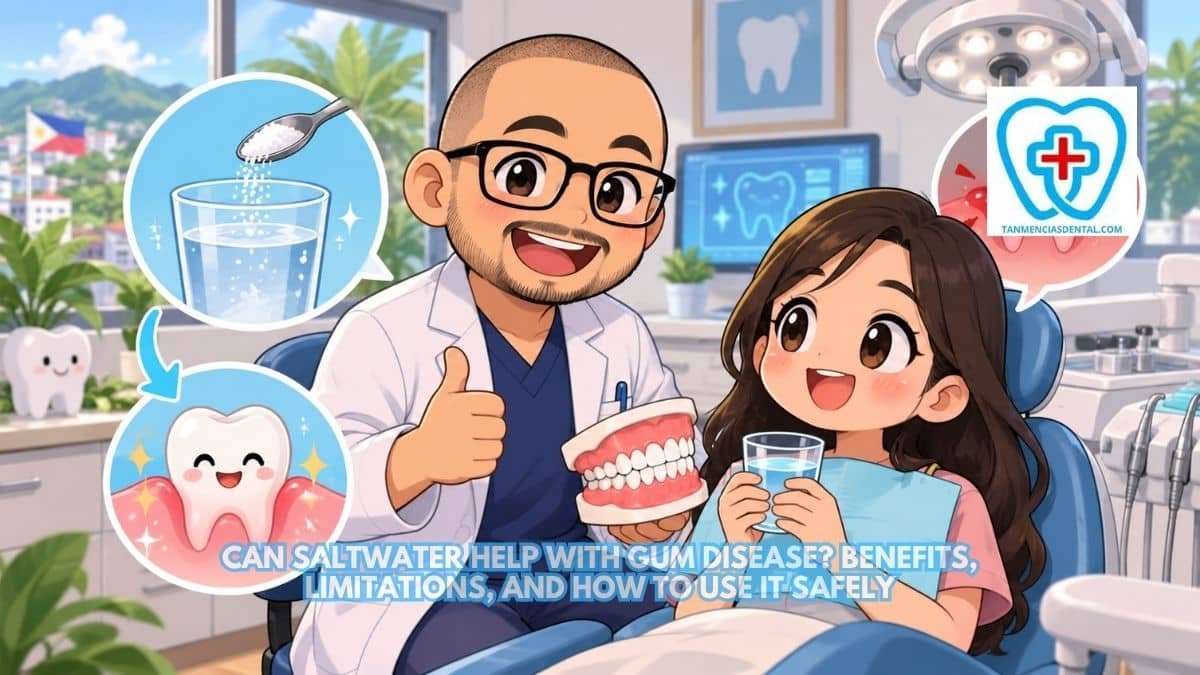
If your gums are swollen, sore, or bleeding, you may have heard that rinsing with saltwater can help.
But does it actually work?
A warm saltwater rinse may help soothe irritated gums and keep your mouth feeling clean, but it is not a cure for gum disease. It cannot remove hardened tartar, clean deep periodontal pockets, or reverse damage caused by periodontitis.
Still, when used properly, saltwater can be a simple and inexpensive supportive measure for temporary gum irritation or during healing when recommended by your dentist.
Let’s look at what saltwater can and can’t do for your gums, how to use it safely, and when you should see a dentist.
Key Takeaways
- Saltwater may temporarily soothe sore, swollen, or irritated gums.
- It can help rinse away loose food particles and debris, but it does not replace brushing or cleaning between your teeth.
- Saltwater cannot remove tartar or cure periodontitis.
- Research on saltwater and gum disease is limited, so it is best considered a supportive measure rather than a primary treatment.
- A simple rinse can be made with about ½ teaspoon of salt dissolved in one cup or glass of warm water.
- Avoid rinsing immediately after brushing with fluoride toothpaste because this can wash away some of the fluoride left on your teeth.
- Persistent bleeding, swelling, gum recession, bad breath, pus, or loose teeth should be evaluated by a dentist.
1. What Is Gum Disease?
Gum disease, also known as periodontal disease, affects the gums and other tissues that support your teeth.
It often begins with gingivitis, the earliest stage of gum disease.
Common signs of gingivitis include:
- Red or swollen gums
- Tender or sensitive gums
- Bleeding when brushing or cleaning between the teeth
- Persistent bad breath
One of the main contributors to gum disease is dental plaque, a sticky biofilm containing bacteria that continually forms on the teeth.
When plaque is not removed effectively through brushing and cleaning between the teeth, it can accumulate along the gumline.
Some plaque eventually hardens into tartar, also called dental calculus.
Once tartar has formed, ordinary brushing, flossing, mouthwash, or saltwater rinsing cannot reliably remove it. Professional dental cleaning is needed.
If gingivitis is not properly managed, it can progress to periodontitis in some people.
Periodontitis is more serious because inflammation affects the deeper tissues and bone that support the teeth. Over time, this can contribute to gum recession, periodontal pockets, loose teeth, and eventually tooth loss.
This is why home remedies such as saltwater should complement, not replace, proper oral hygiene and professional dental care.
🦷 Foods That Cause Gingivitis? What to Limit for Healthier Gums
2. How Can Saltwater Help Your Gums?
A warm saltwater rinse is best thought of as a supportive measure for comfort and cleanliness rather than a treatment for gum disease.
Rinsing can help loosen and wash away some food particles and debris from around the gums.
Warm saltwater may also feel soothing when oral tissues are irritated or tender.
Dentists may sometimes recommend saltwater rinses for a limited period after certain dental procedures to help keep the area clean while the tissues heal.
However, there is an important distinction:
Feeling better does not necessarily mean the underlying gum disease has been treated.
If plaque, tartar, or deeper periodontal inflammation is causing your symptoms, saltwater alone will not solve the problem.
🦷 Simple vs. Surgical Tooth Extraction: What’s the Difference?
3. Does Saltwater Kill the Bacteria That Cause Gum Disease?
Saltwater is sometimes described as a “natural antibacterial mouthwash.”
That’s an oversimplification.
Research suggests that saline solutions may influence oral microorganisms and inflammation under certain conditions. However, ordinary homemade saltwater rinses have not been established as a treatment capable of controlling the bacterial biofilm responsible for gum disease.
Gum disease is also more complicated than simply trying to “kill bacteria.”
Effective management usually focuses on controlling plaque through:
- Proper toothbrushing
- Cleaning between the teeth
- Professional dental cleaning when necessary
- Periodontal treatment when the disease has progressed
- Regular dental follow-up and maintenance
So rather than thinking of saltwater as something that kills the bacteria responsible for gum disease, it is more accurate to think of it as something that may temporarily soothe irritated tissues and help rinse the mouth.
🦷 Can You Brush Your Teeth With Hydrogen Peroxide? Benefits, Risks, and What You Should Know
4. What Does Research Say About Saltwater and Gum Disease?
Research into saline rinses has shown some potential benefits, but the evidence needs to be interpreted carefully.
Some small clinical studies have found that saline rinses may help with inflammation or healing, including in patients following periodontal procedures.
However, these findings do not prove that an ordinary homemade saltwater rinse can treat gingivitis or periodontitis.
Studies may involve different salt concentrations, treatment situations, or groups of patients, making it difficult to apply the results to everyone with gum disease.
The most practical conclusion is:
Saltwater may be useful as a complementary rinse, but it should not be considered a substitute for proven plaque-control methods or professional periodontal treatment.
🦷 What’s the Difference Between Dental Floss and Dental Tape?
5. How to Make a Saltwater Mouth Rinse
A basic saltwater rinse is easy to prepare at home.
You can use approximately:
½ teaspoon of salt dissolved in about one cup or glass of warm water.
The water should be comfortably warm, not hot enough to burn your mouth.
Once the salt has dissolved:
- Take a small amount into your mouth.
- Gently swish it around your gums and teeth.
- Spit it out.
- Continue until you’ve used the prepared rinse.
Do not intentionally swallow the saltwater.
You also don’t need to make the solution extremely salty. A stronger mixture is not necessarily more effective and may irritate sensitive oral tissues.
If you’ve recently had a tooth extraction, periodontal treatment, oral surgery, or another dental procedure, follow the instructions given by your dentist.
For example, vigorous rinsing may be discouraged immediately after certain procedures because it can interfere with early healing.
🦷 Tooth Extraction Aftercare: What to Do and What to Avoid for a Smooth Recovery
6. How Often Should You Rinse With Saltwater?
There is no universal schedule that everyone with gum problems needs to follow.
How often you should use a saltwater rinse depends on why you’re using it.
For short-term irritation or after a dental procedure, your dentist may recommend using it for a limited period.
For general use, there is no good reason to assume that rinsing more frequently will provide greater benefits.
If you’re considering using saltwater several times a day for weeks or months, talk to your dentist first, particularly if the reason is persistent gum bleeding, swelling, or pain.
Most importantly, don’t use repeated saltwater rinsing as a way to postpone a dental examination.
If your gums continue to bleed or swell, the underlying cause needs to be identified.
🦷 How to Clean Teeth After Braces Removal: Tips for Maintaining Your Best Smile
7. Should You Use Saltwater Before or After Brushing?
This is an important point that many people overlook.
Avoid rinsing with saltwater immediately after brushing with fluoride toothpaste.
After brushing, some fluoride remains on the surfaces of your teeth and continues to provide protection against tooth decay.
Rinsing immediately afterward with water, saltwater, or another mouth rinse can wash away some of that fluoride.
A good routine is to brush with fluoride toothpaste and spit out the excess toothpaste without rinsing with water afterward.
If you want to use a saltwater rinse, consider using it at a different time of day unless your dentist has specifically instructed otherwise.
For adults and older children who can reliably spit, toothpaste containing an appropriate amount of fluoride is an important part of preventing tooth decay. In the Philippines, public-health recommendations generally encourage the use of fluoride toothpaste containing around 1,000 to 1,500 ppm fluoride, depending on age and individual needs.
🦷 Can a Dental Hygienist Work as a Dental Assistant in the Philippines?
8. Can Saltwater Remove Plaque or Tartar?
Saltwater cannot replace mechanical cleaning.
Plaque is a soft bacterial biofilm that can largely be controlled through proper brushing and cleaning between the teeth.
Once plaque mineralizes and becomes tartar, however, it becomes firmly attached to the tooth surface.
Saltwater cannot dissolve or remove hardened tartar.
Neither can ordinary brushing or flossing reliably remove established tartar.
Professional dental instruments are needed to remove these deposits safely and effectively.
This becomes particularly important with periodontitis.
Periodontal pockets can form between the gums and teeth, allowing bacterial deposits to accumulate below the gumline. A simple mouth rinse cannot adequately clean these deeper areas.
An easy way to remember this is:
Saltwater can rinse around your gums, but it cannot remove tartar from beneath them.
🦷 Signs You May Need a Tooth Extraction
9. Are There Risks to Using Saltwater?
A mildly prepared saltwater rinse is generally well tolerated when used appropriately.
However, more salt does not mean more benefit.
A solution that is excessively salty may sting or irritate sensitive tissues, especially if your gums or other areas of your mouth are already sore.
You should also spit the solution out rather than deliberately swallowing it.
This may be especially relevant for people who have been advised by a doctor to limit sodium intake because of conditions such as high blood pressure, kidney disease, heart disease, or another medical condition.
If saltwater makes your mouth feel worse, stop using it and ask your dentist for advice.
And if your symptoms continue, don’t simply increase the amount of salt or rinse more frequently.
Persistent gum symptoms may need professional treatment.
🦷 Basic Dental Needs in Marikina
10. Saltwater vs. Therapeutic Mouthwash: Which Is Better?
Saltwater rinses and therapeutic mouthwashes serve different purposes.
Saltwater is inexpensive, easy to prepare, and may temporarily soothe irritated oral tissues.
Therapeutic mouthwashes contain active ingredients designed for specific oral-health purposes.
Depending on the formulation, these may help with concerns such as:
- Plaque
- Gingivitis
- Tooth decay
- Bad breath
Some therapeutic rinses contain ingredients such as cetylpyridinium chloride, essential oils, fluoride, or chlorhexidine.
However, that doesn’t mean everyone with bleeding gums needs an antiseptic mouthwash.
Some products are intended for particular situations or limited periods of use and may have side effects.
For example, chlorhexidine rinses may sometimes be recommended by a dentist for specific conditions or procedures, but they are not something everyone needs as part of their everyday routine.
The best approach is to determine why your gums are inflamed rather than trying one mouth rinse after another.
And remember that mouthwash, whether saltwater or commercially prepared, does not replace brushing and cleaning between the teeth.
🦷 Marikina’s Trusted Family Dentist
11. What Actually Treats Gum Disease?
Treatment depends on how advanced the condition is.
Gingivitis
If you have early gum disease, treatment focuses primarily on removing and controlling plaque.
This may involve:
- Brushing thoroughly with fluoride toothpaste
- Cleaning between your teeth every day
- Professional dental cleaning when needed
- Improving brushing and interdental-cleaning techniques
- Regular dental follow-up
Gingivitis can often improve significantly when plaque is properly controlled, and professional care is provided when needed.
Periodontitis
Periodontitis requires professional evaluation because the disease affects areas that cannot be adequately cleaned with home remedies.
Depending on its severity, treatment may include:
- Professional scaling
- Scaling and root planing or other periodontal debridement
- Improved home plaque control
- Periodontal maintenance
- Additional periodontal procedures when clinically necessary
The exact treatment should be based on an examination by your dentist.
Saltwater may occasionally be used alongside treatment for comfort or postoperative care, but it does not replace periodontal therapy.
12. When Should You See a Dentist?
Occasional mild gum irritation can happen, but persistent symptoms should not be ignored.
Arrange a dental examination if you notice:
- Gums that regularly bleed when brushing or cleaning between the teeth
- Persistent gum redness or swelling
- Gum recession
- Persistent bad breath or an unpleasant taste
- Pus around the gums
- Pain or discomfort when chewing
- Teeth that feel loose or appear to be shifting
- Changes in the way your teeth fit together when you bite
- A buildup of visible tartar
It’s also important to remember that gum disease doesn’t always cause pain.
You can have periodontitis without experiencing significant discomfort.
Regular dental examinations and professional cleaning can therefore help identify problems before they become more difficult to manage.
Can Saltwater Cure Gum Disease?
No.
Saltwater should not be considered a cure for gum disease.
It may temporarily soothe irritated gums and help rinse away loose debris, but successful gum-disease treatment requires addressing the underlying plaque, tartar, inflammation, and other contributing factors.
For gingivitis, this generally involves effective daily plaque control and professional dental care when needed.
For periodontitis, professional periodontal treatment may be necessary to remove deposits from areas below the gumline.
Saltwater can sometimes complement proper dental care.
It should never replace it.
Frequently Asked Questions
1. Does saltwater kill the bacteria that cause gum disease?
Saltwater may affect certain microorganisms under some conditions, but a homemade saltwater rinse should not be relied upon to control the bacterial plaque that contributes to gum disease.
Good brushing, cleaning between the teeth, and professional dental care are more important.
2. Can saltwater cure gingivitis?
No. Saltwater may soothe inflamed gums, but it does not remove all of the plaque or tartar contributing to gingivitis.
Improving plaque control and receiving professional dental cleaning when needed are more effective ways to manage gingivitis.
3. Can saltwater cure periodontitis?
No.
Periodontitis affects the deeper tissues supporting your teeth. Saltwater cannot remove tartar below the gumline, eliminate periodontal pockets, or repair periodontal damage.
Professional evaluation and treatment are necessary.
4. How much salt should I use for a saltwater mouth rinse?
A common preparation is approximately ½ teaspoon of salt in one cup or glass of warm water.
There’s no need to make the mixture very salty.
5. How often can I rinse with saltwater?
It depends on why you’re using it.
Saltwater is generally more appropriate for temporary use, such as soothing mild irritation or following certain dental procedures when your dentist recommends it.
If you feel you need to use it repeatedly for ongoing gum problems, it’s better to have your gums examined.
6. Should I rinse with saltwater after brushing?
Not immediately.
Rinsing right after brushing can wash away some of the fluoride left on your teeth by fluoride toothpaste.
After brushing, spit out the excess toothpaste but don’t rinse with water. If you want to use saltwater, use it at another time of day unless your dentist advises otherwise.
7. Can saltwater remove tartar?
No.
Once plaque hardens into tartar, saltwater, ordinary mouthwash, brushing, and flossing cannot reliably remove it.
Professional dental cleaning is needed.
8. Why are my gums still bleeding even though I’m using saltwater?
Bleeding gums are commonly associated with inflammation, and saltwater does not necessarily address its underlying cause.
If your gums repeatedly bleed, particularly if you also have swelling, gum recession, persistent bad breath, tartar buildup, or loose teeth, schedule a dental examination.
9. Can I use saltwater instead of mouthwash?
They are not necessarily interchangeable.
Saltwater can be useful for temporary soothing or rinsing, while therapeutic mouthwashes contain ingredients designed for particular oral-health purposes.
Neither should replace brushing with fluoride toothpaste and cleaning between your teeth.
If you’re unsure whether you need a therapeutic mouthwash, ask your dentist.
Concerned About Bleeding or Swollen Gums?
Saltwater may provide temporary relief, but gums that repeatedly bleed, swell, recede, or feel uncomfortable deserve more than a home remedy.
At Tan-Mencias Dental Clinic in Parang, Marikina City, we can examine your gums, determine whether you’re dealing with gingivitis, periodontitis, tartar buildup, or another oral-health problem, and recommend treatment based on your individual needs.
Whether you’re due for a regular dental checkup and cleaning or you’re concerned about changes in your gums, our dental team is here to help.
To schedule an appointment, call 0917-145-1074, contact us through our Facebook page, or send us a message using the contact form on our website.
Taking care of gum problems early can help protect your teeth and gums for years to come.
Medical Disclaimer
This article is provided for general educational and informational purposes only. It is not intended to replace professional dental or medical advice, diagnosis, or treatment.
Recommendations may vary depending on your age, medical history, medications, oral-health condition, and any dental procedures you’ve recently undergone.
If you have persistent bleeding, swollen or painful gums, gum recession, pus, loose teeth, persistent bad breath, or other concerns about your oral health, consult a licensed dentist in the Philippines for an appropriate examination, diagnosis, and treatment plan.
If you have recently undergone a tooth extraction, periodontal treatment, oral surgery, or another dental procedure, follow the specific aftercare instructions provided by your dentist rather than relying on general recommendations about saltwater rinsing.