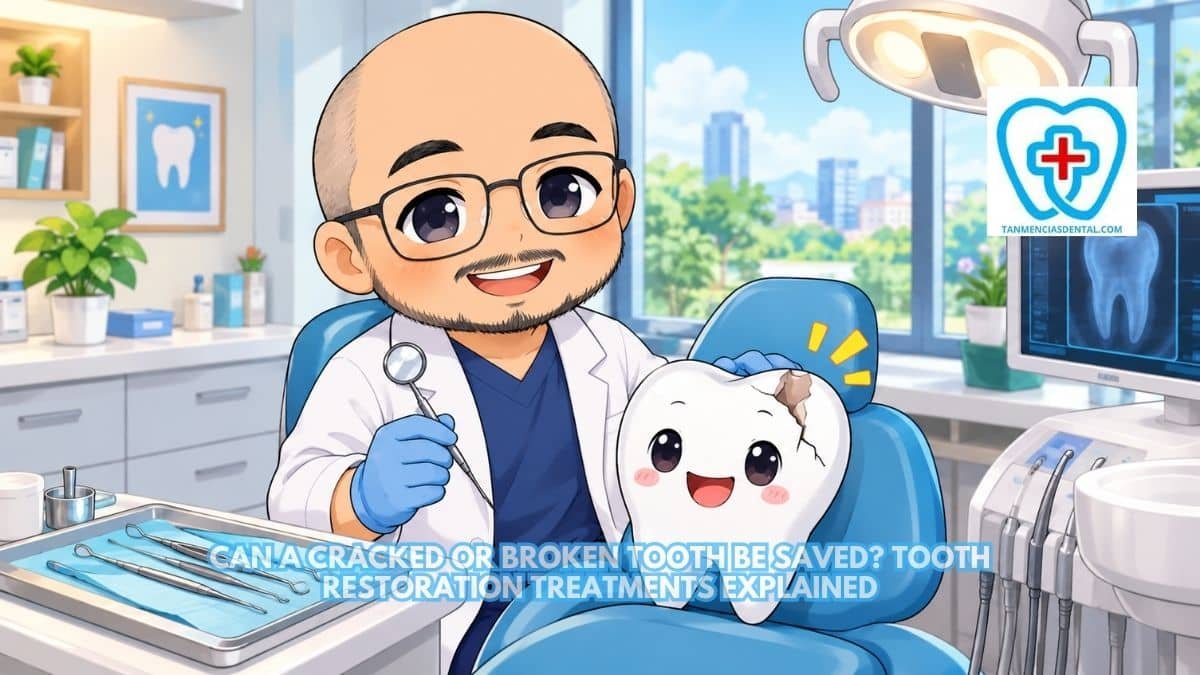
Cracking or breaking a tooth can be alarming, especially when it happens suddenly while you’re eating, biting something hard, or after an accident. You might feel a sharp edge with your tongue, notice that part of the tooth is missing, or experience pain whenever you bite down.
Naturally, one of the first questions you may have is: Can the tooth still be saved?
In many cases, yes.
Modern restorative and endodontic treatments can preserve many cracked, chipped, and broken teeth. Depending on the extent of the damage, treatment may involve dental bonding, a filling, an inlay or onlay, a crown, root canal treatment, or a combination of procedures.
The most important factor is having the tooth evaluated early. A crack will not repair itself, and repeated chewing forces can allow it to spread. The sooner your dentist can determine the extent of the damage, the better the chances of preserving the natural tooth.
Key Takeaways
- Many cracked and broken teeth can be saved, particularly when they are treated early.
- Small chips may be repaired with dental bonding, a tooth-colored filling, smoothing, or reattachment of the broken fragment.
- More substantial fractures may require an inlay, onlay, or dental crown to reinforce the remaining tooth structure.
- If the pulp or nerve inside the tooth becomes irreversibly inflamed or infected, root canal treatment followed by an appropriate restoration may allow the tooth to be retained.
- Some severely split teeth, vertical root fractures, or teeth without enough remaining healthy structure may need to be extracted.
- The amount of pain you feel does not necessarily indicate how serious the fracture is. Some significant cracks produce only mild or intermittent symptoms.
- Early dental assessment generally gives your dentist more options for preserving your tooth.
Chipped, Cracked, or Broken Tooth: What’s the Difference?
People often use these terms interchangeably, but dentists distinguish between different types of tooth fractures because treatment and prognosis can vary.
Chipped Tooth
A chipped tooth usually occurs when a small portion of enamel breaks away.
Small chips may cause little more than a rough edge or cosmetic concern. Larger chips may expose the underlying dentin, which can make the tooth sensitive to cold, heat, sweets, or pressure.
Fractured Cusp
A fractured cusp occurs when part of the chewing surface of a tooth breaks away, commonly around a large filling.
These fractures do not always involve the pulp or nerve of the tooth. Depending on the amount of remaining tooth structure, treatment might involve a filling, onlay, or crown.
Cracked Tooth
A cracked tooth contains a fracture extending through part of the tooth, often beginning on the chewing surface.
Unlike a completely split tooth, the pieces usually have not separated.
The depth and direction of the crack are particularly important. A relatively shallow crack may be managed with restorative treatment, while a deeper crack affecting the pulp or supporting tissues may require more extensive treatment.
Split Tooth
A split tooth occurs when a crack progresses to the point that portions of the tooth separate.
A completely split tooth generally has a poorer prognosis than a simple crack. However, your dentist must examine the exact fracture pattern before determining whether all or part of the tooth can be retained.
🦷 How Do Holistic Dentists Treat Cavities? Prevention, Remineralization, and Fillings
How Does a Dentist Determine Whether a Tooth Can Be Saved?
There is no single rule that applies to every broken or cracked tooth. Your dentist will usually evaluate several factors.
How Deep Is the Crack?
Generally, the deeper the fracture extends, the more complicated treatment becomes.
A crack confined mainly to the crown of the tooth often has a better prognosis than one extending deeply toward the root.
However, the presence of a deep crack does not automatically mean extraction is required. Some teeth with deeper cracks may still be successfully treated and restored, depending on the location of the crack, the health of the surrounding tissues, and the amount of healthy tooth structure remaining.
How Much Healthy Tooth Structure Remains?
The dentist needs enough healthy tooth structure to support a durable restoration.
For example, a tooth with a significant fracture may still be restored with a crown if there is sufficient sound tooth structure above and around the gumline.
When very little usable tooth remains, or when the fracture extends deeply into the root, predictable restoration may become difficult.
Is the Pulp Healthy?
The pulp is the soft tissue at the center of the tooth containing nerves, connective tissue, and blood vessels.
A crack can allow bacteria to reach the pulp. Depending on the extent of inflammation, the pulp may initially recover or may eventually become irreversibly inflamed or infected.
If the pulp is irreversibly damaged or infected, root canal treatment may be needed to save the tooth.
Are the Root and Supporting Tissues Healthy?
Your dentist will also consider the root, gums, bone, and periodontal tissues surrounding the tooth.
Certain fractures, particularly vertical root fractures or cracks associated with significant periodontal breakdown, may substantially reduce the chances of successfully retaining the tooth.
🦷 Baby Gingivitis: Signs, Prevention, Treatment, and When to See a Dentist
What Does a Cracked Tooth Feel Like?
The symptoms of a cracked tooth can vary considerably.
You might experience:
- Sharp pain when biting or chewing
- Pain when releasing your bite
- Sensitivity to cold, hot, or sweet foods and drinks
- Intermittent toothache
- Discomfort that is difficult to pinpoint
- Tenderness around the tooth
- A rough or sharp edge if part of the tooth has broken
- Swelling if infection develops
Some cracked teeth cause surprisingly little discomfort.
That’s why you shouldn’t assume a tooth is fine simply because it doesn’t hurt. A dental examination is the best way to determine how serious the damage is.
🦷 Dental Filling vs. Dental Crown: How Do Dentists Decide Which You Need?
Tooth Restoration Treatments for Cracked or Broken Teeth
Treatment depends on the location and severity of the damage, the condition of the pulp, the amount of remaining tooth structure, your bite, and the overall health of the tooth.
Here are some of the treatments your dentist may consider.
1. Dental Bonding
Often used for: Small chips and minor fractures.
Dental bonding uses a tooth-colored composite resin to rebuild the damaged portion of the tooth.
The material is applied, shaped, and hardened so that it blends with the surrounding tooth.
Bonding is particularly useful for relatively small chips, including cosmetic damage to front teeth.
Because it usually requires minimal removal of healthy tooth structure, it can be a conservative treatment option.
However, bonding may not provide enough strength for a tooth with a large fracture or significant structural weakness.
2. Dental Filling
Often used for: Small to moderate areas of missing tooth structure.
If a relatively small portion of the tooth has fractured and sufficient healthy tooth remains, a filling may be suitable.
Tooth-colored composite restorations are commonly used, although your dentist will select the material according to the location and function of the tooth.
Larger fractures may require a stronger restoration instead.
3. Inlay or Onlay
May be used for: Moderate fractures where more support is needed than a filling can provide.
An inlay or onlay is a custom-made restoration used to replace damaged portions of a tooth while preserving healthy tooth structure.
An onlay can cover one or more weakened cusps and may be considered in certain cracked or fractured posterior teeth.
Whether an onlay or a full crown is more appropriate depends on the location and extent of the fracture and your dentist’s assessment of the tooth.
4. Reattaching the Broken Tooth Fragment
May be used for: Certain traumatic fractures where the broken piece remains intact.
If part of your tooth breaks off, don’t immediately throw the fragment away.
In selected cases, the dentist may be able to bond the original tooth fragment back into position.
Place the fragment in a clean container and keep it moist. Milk or the patient’s own saliva may be used temporarily while you travel to the dental clinic.
Bring the fragment with you so your dentist can determine whether reattachment is possible.
5. Dental Crown
Often used for: Larger fractures and structurally weakened teeth.
A dental crown is a custom restoration that covers most or all of the visible part of a tooth.
It can reinforce weakened tooth structure, restore normal shape and function, and help protect a cracked tooth from forces generated during biting and chewing.
Crowns are commonly considered for posterior teeth with significant cracks or fractures.
However, a crown cannot make the crack itself disappear, nor can it guarantee that a crack will never progress.
Its purpose is to reinforce and protect the tooth as much as possible.
6. Root Canal Treatment
Often used for: Teeth where the pulp has become irreversibly inflamed, damaged, or infected.
A root canal does not mean your tooth has failed.
In fact, the purpose of root canal treatment is often to save a natural tooth that would otherwise be at risk of extraction.
During treatment, the dentist or endodontist removes the affected pulp tissue, cleans and disinfects the root canal system, and then fills and seals it.
The tooth then requires an appropriate final restoration.
For many cracked posterior teeth that undergo root canal treatment, a full-coverage crown or another cuspal-coverage restoration may be recommended to help protect the remaining tooth structure from chewing forces.
7. Tooth Extraction
May be necessary for: Teeth that cannot be predictably restored.
Unfortunately, some fractures are too severe for the tooth to be saved.
Extraction may be recommended when there is:
- A complete split that makes restoration impossible
- Certain vertical root fractures
- Extensive damage extending deeply into the root
- Severe periodontal damage associated with the fracture
- Insufficient healthy tooth structure for a durable restoration
- Other factors making long-term restoration unpredictable
The decision should be based on the condition of the individual tooth rather than simply on the presence of a crack.
If extraction becomes necessary, your dentist can discuss tooth replacement options.
Depending on your oral health, preferences, anatomy, and budget, these may include a dental implant, fixed dental bridge, or removable partial denture.
🦷 Does Brushing Your Teeth Whiten Them? What Brushing Can, and Can’t, Do
Do All Cracked Teeth Need a Root Canal?
No.
Having a cracked tooth does not automatically mean you need root canal treatment.
If the pulp remains healthy or has only reversible inflammation, your dentist may be able to stabilize and restore the tooth without root canal treatment.
Root canal treatment is generally considered when the pulp becomes irreversibly inflamed, necrotic, or infected.
This is another reason early diagnosis matters. Treating and protecting a cracked tooth before significant pulpal damage occurs may allow for more conservative management.
🦷 Tooth Restoration Options: Which Treatment Is Right for Your Damaged Tooth?
Can a Cracked Tooth Heal on Its Own?
No. A true structural crack in a tooth does not heal in the same way that a fractured bone can.
Enamel and dentin cannot simply fuse themselves back together once a significant fracture has formed.
Dental treatment may therefore be needed to reinforce the tooth and reduce the risk of further crack progression.
However, very fine superficial enamel lines known as craze lines are different. They typically involve only the enamel and are common in adults.
Craze lines are often harmless and may require no treatment unless they create a cosmetic concern.
A dentist can determine whether what you’re seeing is a superficial craze line or a more significant structural crack.
🦷 Broken Tooth Causing Jaw Pain? Causes, Symptoms, and Treatment
What Happens If You Ignore a Cracked Tooth?
Some cracks remain stable for a period of time, while others can gradually worsen.
Repeated chewing forces may cause a fracture to progress. A deeper crack can also create a pathway through which bacteria reach the pulp.
Possible complications include:
- Increasing sensitivity
- Pain while chewing
- Inflammation of the pulp
- Pulp necrosis
- Dental infection
- Dental abscess
- Further fracture or splitting of the tooth
- Periodontal damage
- Eventual tooth loss
A tooth that can be treated relatively conservatively today may require more extensive treatment if the damage progresses.
That’s why having a suspected crack evaluated early is generally the safest approach.
🦷 Dry Socket After Tooth Extraction: Symptoms, Causes, Prevention, and Treatment
What Should You Do If You Just Broke a Tooth?
If you’ve just broken or cracked a permanent tooth, contact your dentist or a nearby dental clinic and arrange an assessment.
Until you’re examined:
- Avoid chewing on the affected side.
- Avoid very hard or crunchy foods.
- Keep the area reasonably clean.
- If a piece of tooth has broken off, keep it moist and bring it to your dentist.
- Do not place aspirin directly against the tooth or gums, as this may irritate or burn the tissue.
- Do not attempt to permanently repair the tooth yourself using household adhesives or other materials.
If the injury also caused significant bleeding, facial trauma, or a possible jaw injury, seek urgent medical or dental assessment.
Significant facial swelling, fever, difficulty swallowing, difficulty breathing, or rapidly worsening symptoms require urgent medical attention, as these can indicate a spreading infection or another serious problem.
🦷 Can Saltwater Help With Gum Disease? Benefits, Limitations, and How to Use It Safely
Can a Cracked or Broken Tooth Be Saved?
In many situations, yes.
Small chips may need only bonding or a filling. Moderate fractures may be restored with an inlay, onlay, or crown. Teeth in which the pulp has become severely damaged may still be preserved through root canal treatment followed by an appropriate restoration.
The deciding factor is not simply whether the tooth is cracked. Your dentist needs to determine:
- Where the fracture is located
- How deeply it extends
- Whether the pulp is involved
- Whether the root and surrounding tissues are healthy
- How much usable tooth structure remains
- Whether the tooth can withstand normal biting forces after treatment
Even some deeper cracks can have favorable outcomes when carefully diagnosed and appropriately treated.
At the same time, not every tooth can be predictably restored. Completely split teeth, certain vertical root fractures, and teeth with extensive structural or periodontal damage may need to be removed.
If you’ve noticed a crack, chip, missing piece of tooth, unexplained sensitivity, or pain when chewing, don’t rely on symptoms alone to tell you how serious it is.
Have your dentist examine the tooth as soon as reasonably possible. Early diagnosis generally gives you the best opportunity to preserve your natural tooth.
🦷 Basic Dental Needs in Marikina
Frequently Asked Questions
1. Can half of a broken tooth still be saved?
Sometimes.
The amount of the visible crown that has broken away is only one factor. Your dentist also needs to assess the condition of the root, pulp, gums, supporting bone, and remaining tooth structure.
Some severely broken teeth can still be rebuilt and covered with a crown. Others may not have enough healthy structure to support a reliable restoration.
2. Can a tooth cracked toward the root still be saved?
Possibly.
A deeper crack generally has a less predictable prognosis than a shallow one, but depth alone does not always determine whether extraction is necessary.
Some teeth with deeper crack extensions can still be successfully treated. Your dentist or an endodontist will evaluate the location of the crack, periodontal involvement, pulp status, remaining tooth structure, and restorability before recommending treatment.
3. Does a cracked tooth always hurt?
No.
Some cracked teeth produce sharp pain while chewing or temperature sensitivity, while others cause only occasional discomfort or no obvious symptoms at all.
Absence of pain does not necessarily mean the tooth is healthy.
4. How long can I wait before having a cracked tooth treated?
There is no reliable way to predict whether or how quickly a crack will progress.
For that reason, it is better to arrange a dental assessment rather than intentionally wait for symptoms to worsen.
Early evaluation may provide more conservative treatment options.
5. Will a dental crown stop a crack from getting worse?
A crown or another cuspal-coverage restoration can reinforce a weakened tooth and reduce movement of fractured sections during chewing.
However, no restoration can guarantee that an existing crack will never progress.
Your dentist will determine whether a crown or another type of restoration offers a reasonable long-term prognosis for your tooth.
6. Can a broken tooth be repaired without a root canal?
Yes.
Root canal treatment is not automatically required simply because a tooth has broken.
If the pulp remains healthy, treatment may involve bonding, a filling, fragment reattachment, an inlay, an onlay, or a crown.
Root canal treatment becomes more likely when the pulp is irreversibly inflamed, necrotic, infected, or significantly exposed.
7. Is it better to have a root canal or extract the tooth?
That depends on whether the tooth can be predictably restored.
When a natural tooth has a reasonable long-term prognosis, root canal treatment and restoration may allow it to remain functional for many years.
Extraction may be the better option when the tooth is structurally non-restorable, has certain severe root fractures, or has a poor periodontal prognosis.
Your dentist should discuss the expected benefits, limitations, prognosis, costs, and replacement options with you before treatment.
8. Who performs root canal treatment in the Philippines?
General dentists in the Philippines may perform root canal treatment depending on the complexity of the case and their training and experience.
More complex cases may be referred to an endodontist, a dentist with advanced training in diagnosing and treating diseases and injuries involving the dental pulp and tissues around the roots.
9. Can I repair a cracked tooth at home?
No.
Home measures may temporarily reduce irritation or discomfort, but they cannot permanently repair a structural crack.
Avoid household glue, temporary DIY repair materials not intended for dental use, or placing aspirin directly on the affected tooth or gum.
A dentist needs to determine the extent of the damage and the appropriate treatment.
🦷 Skilled Dentistry in Marikina City
Have Your Cracked or Broken Tooth Checked Today
If you have a cracked, chipped, or broken tooth, visit Tan-Mencias Dental Clinic at 44 G. Del Pilar Street, Parang, Marikina City. Our dental team can check your tooth and explain the treatment options that may help save it. If you have questions or concerns, you can call our clinic or contact us at 0917-145-1074. You can also send us a message through our Facebook page or through the contact form on our website. We are here to help you understand your options and take the next step toward caring for your smile.
Medical Disclaimer
This article is provided for general educational and informational purposes only. It is not intended to replace an examination, diagnosis, or individualized treatment advice from a licensed dentist or other qualified healthcare professional.
The prognosis and treatment of a cracked or broken tooth depend on factors that cannot be reliably assessed without a clinical examination and, when appropriate, dental imaging and other diagnostic tests.
If you have a chipped, cracked, or broken tooth, contact a licensed dentist for proper evaluation. Seek urgent dental or medical care if you develop severe or rapidly increasing facial swelling, fever with significant dental infection, difficulty swallowing, difficulty breathing, uncontrolled bleeding, or significant facial or jaw trauma.