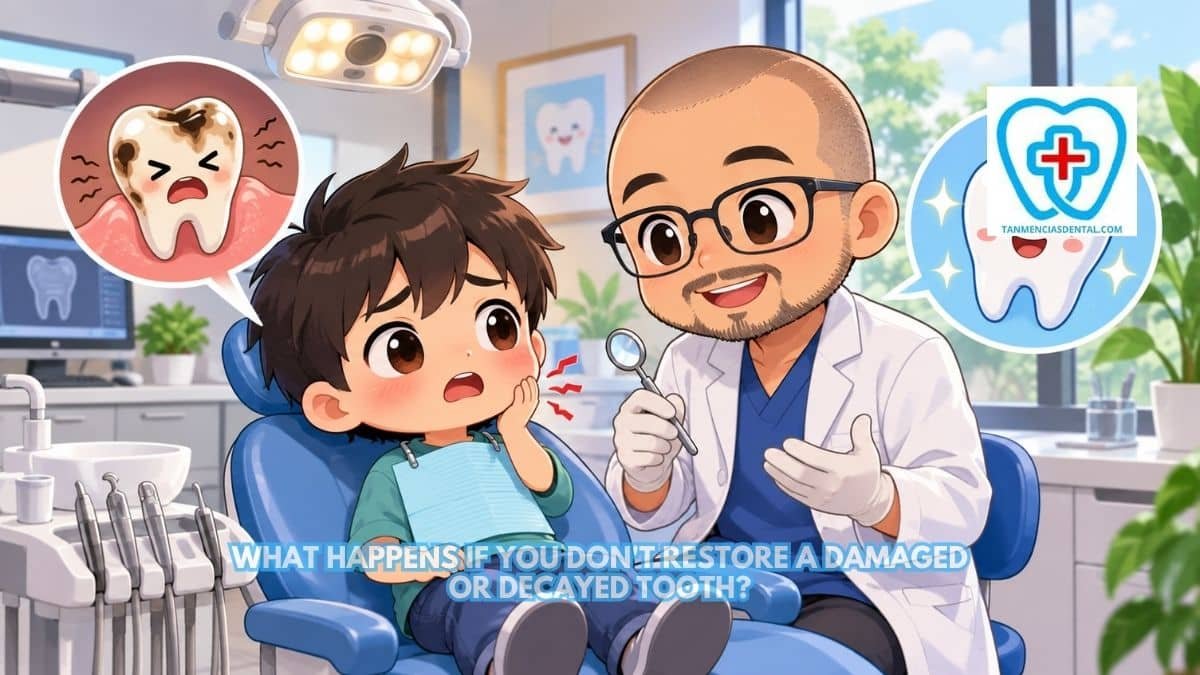
A chipped tooth that doesn’t hurt. A small cavity you barely notice. An old filling that has cracked around the edges. These problems can be easy to put off, especially when you can still eat normally and aren’t experiencing much pain.
But a damaged or decayed tooth shouldn’t be ignored simply because it isn’t painful.
Very early tooth decay, before a cavity develops, may sometimes be stopped or reversed through measures such as fluoride treatment, good oral hygiene, and appropriate dietary changes. Once tooth structure has been permanently lost, however, it cannot simply grow back on its own. Depending on the condition of the tooth, professional dental treatment may be necessary.
Treatment might involve a filling or another type of restoration. A tooth that has lost substantial structure may require a crown or other restorative treatment. If the pulp, the soft tissue containing nerves and blood vessels inside the tooth, becomes irreversibly inflamed or infected, root canal treatment may be necessary. And when a tooth is too severely damaged to be predictably restored, extraction may be recommended.
So, what can happen if you leave a damaged or decayed tooth untreated? Let’s take a closer look.
Key Takeaways
- Early tooth decay may not cause any symptoms, so a tooth can have a problem even when it doesn’t hurt.
- Early, non-cavitated decay may sometimes be arrested or reversed, but tooth structure lost to an established cavity does not naturally grow back.
- Untreated decay can progress deeper into the tooth and eventually affect the pulp.
- A structurally damaged tooth may become weaker and more susceptible to further fracture.
- Advanced decay can cause pain, infection, and a dental abscess.
- Dental infections can sometimes spread into surrounding tissues and, in severe cases, become a medical emergency.
- As damage becomes more extensive, treatment may become more complex.
- Having a damaged or decayed tooth evaluated early gives your dentist more options for preserving the natural tooth.
Tooth Decay Usually Progresses Over Time
To understand why treatment matters, it helps to know a little about the structure of a tooth.
The visible portion of the tooth is covered by enamel, its hard outer layer. Beneath the enamel is dentin, which is less resistant to decay. Deeper inside is the pulp, which contains nerves, blood vessels, and connective tissue.
Tooth decay develops through interactions between bacteria in dental plaque, fermentable carbohydrates such as sugars and starches, and the tooth surface. Bacteria metabolize these carbohydrates and produce acids, which can cause minerals to leave the enamel.
During the earliest stage, before the enamel surface has physically broken down, this mineral loss may potentially be arrested or reversed.
If the disease process continues, however, the tooth can develop a cavity. Once tooth structure has been permanently lost, professional management is needed to prevent or control further damage.
Physical damage presents a somewhat different problem. A chipped, cracked, fractured, or heavily restored tooth may have weakened structure. Depending on the type and extent of damage, continued biting forces can make the problem worse.
🦷 Should You Use Mouthwash Before or After Brushing Teeth?
What Can Happen If You Leave the Tooth Untreated?
1. The Decay or Damage Can Become More Extensive
A small cavity doesn’t necessarily stay small.
Without effective control or treatment, tooth decay can continue to destroy tooth structure. As the cavity becomes larger, more of the tooth may need to be treated.
Structural damage can also progress. For example, repeatedly chewing on a weakened tooth may increase the risk of additional fracture, although the behavior of a crack depends on its location and severity.
This is one reason dentists generally prefer to identify and manage dental problems before extensive tooth structure is lost.
🦷 How Long Do Tooth Restorations Last? A Guide to Fillings, Crowns, Bonding, and Veneers
2. You May Develop Tooth Sensitivity
As decay progresses, you may begin noticing sensitivity.
Your tooth might react to:
- Cold drinks or foods
- Hot foods or beverages
- Sweet foods and drinks
- Cold air
- Pressure while chewing
Sensitivity can have many causes, so it doesn’t automatically mean you have advanced tooth decay. However, new or persistent sensitivity is a good reason to have the tooth examined.
Symptoms may also come and go. Feeling better for a while doesn’t necessarily mean the underlying problem has disappeared.
🦷 Can a Cracked or Broken Tooth Be Saved? Tooth Restoration Treatments Explained
3. Tooth Pain May Develop
When decay becomes deeper, it can irritate the tissues inside the tooth.
What begins as occasional sensitivity may eventually develop into a toothache. Depending on the condition, you may experience pain when chewing, lingering sensitivity to hot or cold, spontaneous pain, or throbbing discomfort.
But here’s something important: early tooth decay often causes no symptoms at all.
You don’t need to have a toothache to have a cavity.
That’s why relying on pain as your signal to visit the dentist can allow some dental problems to progress unnoticed.
🦷 How Do Holistic Dentists Treat Cavities? Prevention, Remineralization, and Fillings
4. The Tooth Can Become Weaker and Break
Decay destroys tooth structure.
As more tooth structure is lost, the remaining portions may become less capable of withstanding normal biting and chewing forces. Teeth that already have large restorations, cracks, or fractures may also have reduced structural integrity.
Eventually, part of a weakened tooth may fracture.
When enough healthy tooth structure remains, the tooth may still be restored. Depending on the situation, treatment could involve a filling, inlay, onlay, crown, or another restorative approach.
If the damage becomes too extensive, however, preserving the tooth may become more difficult or impossible.
🦷 Baby Gingivitis: Signs, Prevention, Treatment, and When to See a Dentist
5. Decay Can Reach the Pulp
The pulp is located inside the tooth and contains nerves, blood vessels, and connective tissue.
As decay progresses toward this area, the pulp can become inflamed. If bacteria enter and infect the pulp, the tissue may eventually die.
At this stage, simply placing a filling may not solve the problem.
When the pulp is irreversibly inflamed or infected, and the tooth can still be saved, root canal treatment may be recommended. This involves removing the affected pulp tissue, cleaning and disinfecting the root canal system, and sealing the tooth. The tooth is then restored appropriately to protect its remaining structure.
🦷 Dental Filling vs. Dental Crown: How Do Dentists Decide Which You Need?
6. A Dental Abscess Can Develop
An untreated dental infection can lead to an abscess, which is a localized collection of pus caused by infection.
Possible symptoms include:
- Severe or persistent toothache
- Swelling of the gums, face, or jaw
- Pain when biting or chewing
- A bad taste in the mouth or drainage near the tooth
- Fever
- Tender or swollen lymph nodes
- Difficulty opening the mouth in more severe cases
A suspected dental abscess requires prompt professional assessment.
Treatment depends on the source and severity of the infection and may involve drainage, root canal treatment, extraction, or other dental procedures. Antibiotics may be prescribed when clinically indicated, particularly when there are signs that infection is spreading or affecting the patient systemically.
Antibiotics alone generally do not eliminate the underlying dental cause. The source of the infection still needs appropriate dental treatment.
🦷 Does Brushing Your Teeth Whiten Them? What Brushing Can, and Can’t, Do
7. Infection Can Spread Beyond the Tooth
Most dental infections can be treated successfully when they receive appropriate care, but an untreated infection can sometimes spread beyond the affected tooth.
It may extend into surrounding tissues of the face, jaw, or neck. Severe spreading infections can potentially compromise the airway or cause systemic illness.
Seek urgent dental or medical care if you develop significant or rapidly increasing facial or mouth swelling, fever accompanied by worsening swelling, difficulty opening your mouth, or feel seriously unwell.
Go to the nearest hospital emergency department immediately if swelling is affecting your ability to breathe or swallow.
These complications are uncommon, but they are important reasons not to ignore a worsening dental infection.
🦷 Tooth Restoration Options: Which Treatment Is Right for Your Damaged Tooth?
8. You Could Eventually Lose the Tooth
One of the goals of restorative and endodontic dentistry is to preserve natural teeth when doing so is clinically appropriate.
However, there is a limit to how much damage some teeth can sustain.
If decay or fracture destroys too much tooth structure, or if the tooth cannot be predictably treated and restored, extraction may be recommended.
After extraction, your dentist can discuss whether the missing tooth should be replaced and which options are suitable. Depending on your individual situation, these may include a dental implant, fixed bridge, or removable denture.
🦷 Basic Dental Needs in Marikina
Why Doesn’t a Cavity Just Heal on Its Own?
This is an understandable question because many tissues in the body can repair themselves after an injury.
Teeth work differently.
In the early stages of tooth decay, enamel that has lost minerals but has not yet developed a cavity may undergo remineralization. Minerals in saliva, together with fluoride and good oral hygiene, can help strengthen these areas.
But once the tooth surface has physically broken down and tooth structure has been lost, that missing structure does not naturally regenerate.
There is therefore an important difference between early, non-cavitated tooth decay and an established cavity.
This is another reason early detection matters: some early lesions may be managed without drilling, depending on their location, activity, and severity.
🦷 Excellent Dental Services In Marikina
Does Every Cavity Need a Filling?
Not necessarily.
Very early decay without a physical cavity may sometimes be managed with preventive or non-operative treatments. Depending on the lesion and the patient’s risk of developing further decay, a dentist may recommend fluoride treatments, improved plaque control, dietary changes, sealants, or other evidence-based approaches.
Once a cavity has caused structural loss, restorative treatment is commonly necessary. The specific treatment depends on factors such as the cavity’s size and location and how much healthy tooth structure remains.
Your dentist can determine the appropriate approach after examining the tooth.
Does Every Damaged Tooth Need a Crown?
No.
A crown is only one of several ways to restore a damaged tooth.
The appropriate treatment depends on factors such as:
- How much healthy tooth structure remains
- The location and extent of the damage
- Whether the pulp is healthy
- The condition of the tooth’s roots and supporting tissues
- Your bite and the forces placed on the tooth
- Whether there is an existing restoration
A relatively small defect may be managed with a filling or another conservative restoration. A more extensively damaged tooth may require an inlay, onlay, crown, or other restorative treatment.
If the pulp has become irreversibly inflamed or infected, root canal treatment may be required before the tooth receives its final restoration.
If the tooth cannot be predictably saved, extraction may be recommended.
What If the Tooth Doesn’t Hurt?
You should still have a known or suspected problem checked.
Pain is useful as a warning sign, but it isn’t a reliable measure of the severity of every dental condition.
Early tooth decay commonly produces no symptoms. Some cracks, defective restorations, and other dental problems may also cause little or no discomfort initially.
Waiting for severe pain before seeing a dentist can therefore mean waiting until the problem has become more extensive.
Consider scheduling a dental examination if you notice a visible hole, broken tooth, crack, damaged filling, persistent sensitivity, swelling, discoloration, or an unexplained change in how a tooth feels when you bite.
Why Early Dental Care Matters
Dental problems don’t all progress at the same speed, and not every damaged tooth will follow the same course.
However, untreated tooth decay can broadly progress from:
Early mineral loss → cavity formation → deeper decay → pulp involvement → infection or abscess → possible tooth loss
The earlier the problem is identified, the more opportunities your dentist may have to use preventive or conservative treatment and preserve healthy tooth structure.
That doesn’t mean every early area of decay automatically requires a filling. Some early lesions can be managed preventively or non-operatively when detected soon enough.
The important thing is to have the tooth assessed so your dentist can determine whether it should be monitored, treated preventively, restored, or managed in another way.
How Can You Protect Your Teeth?
Preventing new decay is just as important as treating existing damage.
Brush thoroughly at least twice a day using fluoride toothpaste, and clean between your teeth regularly with dental floss or another appropriate interdental cleaner.
Try to limit how frequently your teeth are exposed to sugary foods and drinks, particularly between meals. Frequent sugar exposure gives decay-causing bacteria repeated opportunities to produce acids that attack tooth enamel.
Regular dental examinations are also important. They allow your dentist to identify tooth decay, damaged restorations, gum problems, and other concerns that may not yet be causing symptoms.
Remember that restorations also require monitoring. Fillings, crowns, and other dental restorations can wear, fracture, loosen, or develop problems around their margins over time.
The Bottom Line
Leaving a damaged or decayed tooth untreated because it doesn’t hurt can allow the problem to become more difficult to manage.
Tooth decay may progress without obvious symptoms. A weakened tooth may fracture, and deeper decay can eventually involve the pulp and lead to pain or infection. In severe cases, an abscess may develop, and the tooth may eventually become impossible to save.
At the same time, not every early area of decay automatically requires a filling. Some early lesions can be managed preventively or non-operatively when detected soon enough.
That’s why having the tooth evaluated early is so valuable.
If you’ve noticed a cavity, chipped or cracked tooth, damaged filling, persistent sensitivity, swelling, or another change in a tooth, consult a licensed dentist. An examination and dental X-rays, when clinically necessary, can help determine the extent of the problem and the most appropriate treatment.
Frequently Asked Questions
1. Can a decayed tooth heal without a filling?
It depends on how far the decay has progressed. Very early decay that has not yet formed a cavity may sometimes be arrested or reversed through remineralization, fluoride, good oral hygiene, and appropriate dietary changes. Once tooth structure has been permanently lost and a cavity has formed, however, the missing structure does not naturally grow back. A dentist can determine whether preventive management or restorative treatment is appropriate.
2. How long can you leave a cavity untreated?
There is no universally safe amount of time. Tooth decay progresses at different rates depending on factors such as the lesion’s location and severity, oral hygiene, diet, saliva, fluoride exposure, and individual risk of developing decay.
Because cavities can progress without significant pain, don’t use the absence of symptoms as a reason to delay an assessment.
3. What happens if decay reaches the nerve?
When deep decay affects the pulp, the tissue containing nerves and blood vessels, it can cause inflammation or infection. If the pulp becomes irreversibly inflamed or infected, root canal treatment may be necessary to save the tooth. If the tooth cannot be predictably restored, extraction may be recommended.
4. Can an infected tooth make you sick?
Yes. A dental infection can spread from the tooth into surrounding tissues. Severe infections may cause facial or neck swelling, fever, difficulty opening the mouth, and other symptoms. Rarely, a spreading dental infection can become life-threatening.
Seek immediate medical attention at a hospital if swelling interferes with breathing or swallowing.
5. Do antibiotics cure an infected tooth?
Not usually by themselves. Antibiotics may be necessary for certain dental infections, particularly when an infection is spreading or there are systemic symptoms, but the underlying source generally still requires dental treatment. Depending on the condition, that may involve drainage, root canal treatment, extraction, or another procedure.
Do not self-medicate with leftover antibiotics. Consult a dentist or physician for appropriate treatment.
6. Why did my tooth stop hurting even though I didn’t have it treated?
The disappearance of pain does not necessarily mean the tooth has healed. Dental symptoms can fluctuate, and a severely damaged or infected pulp may eventually lose its ability to respond normally.
If you’ve had significant tooth pain that suddenly disappears without treatment, the tooth should still be examined by a dentist.
7. Is it always better to save a damaged tooth instead of having it extracted?
The appropriate treatment depends on the individual tooth and patient. Your dentist will consider how much healthy tooth structure remains, the condition of the pulp and roots, the supporting bone and gums, the presence of cracks or infection, and whether the tooth can be predictably restored.
When a tooth can be appropriately treated and restored, preserving it may be possible. When it is considered non-restorable or has a poor prognosis, extraction may be recommended.
8. When should I see a dentist urgently?
Arrange prompt dental care if you have severe or persistent tooth pain, facial or gum swelling, pus or drainage, fever associated with a dental problem, or signs of an abscess.
Seek emergency medical care at the nearest hospital if you develop substantial or rapidly spreading swelling or have difficulty breathing or swallowing.
Have a Damaged or Decayed Tooth? Visit Tan-Mencias Dental Clinic
If you have a damaged or decayed tooth, getting it checked early may help prevent the problem from getting worse. Visit Tan-Mencias Dental Clinic at 44 G. Del Pilar Street, Parang, Marikina City for a dental checkup and proper treatment. If you have questions or concerns, you can call our clinic or contact us at 0917-145-1074. You can also send us a message through our Facebook page or our website’s contact form. Our team will be happy to answer your questions and help you take the next step in caring for your teeth.
Medical Disclaimer
This article is intended for general educational and informational purposes only. It is not a substitute for professional dental or medical advice, diagnosis, or treatment. Dental conditions and appropriate treatments vary from person to person. Consult a licensed dentist in the Philippines or another qualified healthcare professional for advice regarding your individual condition. If you have severe or rapidly increasing swelling, difficulty breathing or swallowing, or other signs of a medical emergency, seek immediate medical care at the nearest hospital.